.png?width=140&quality=70)
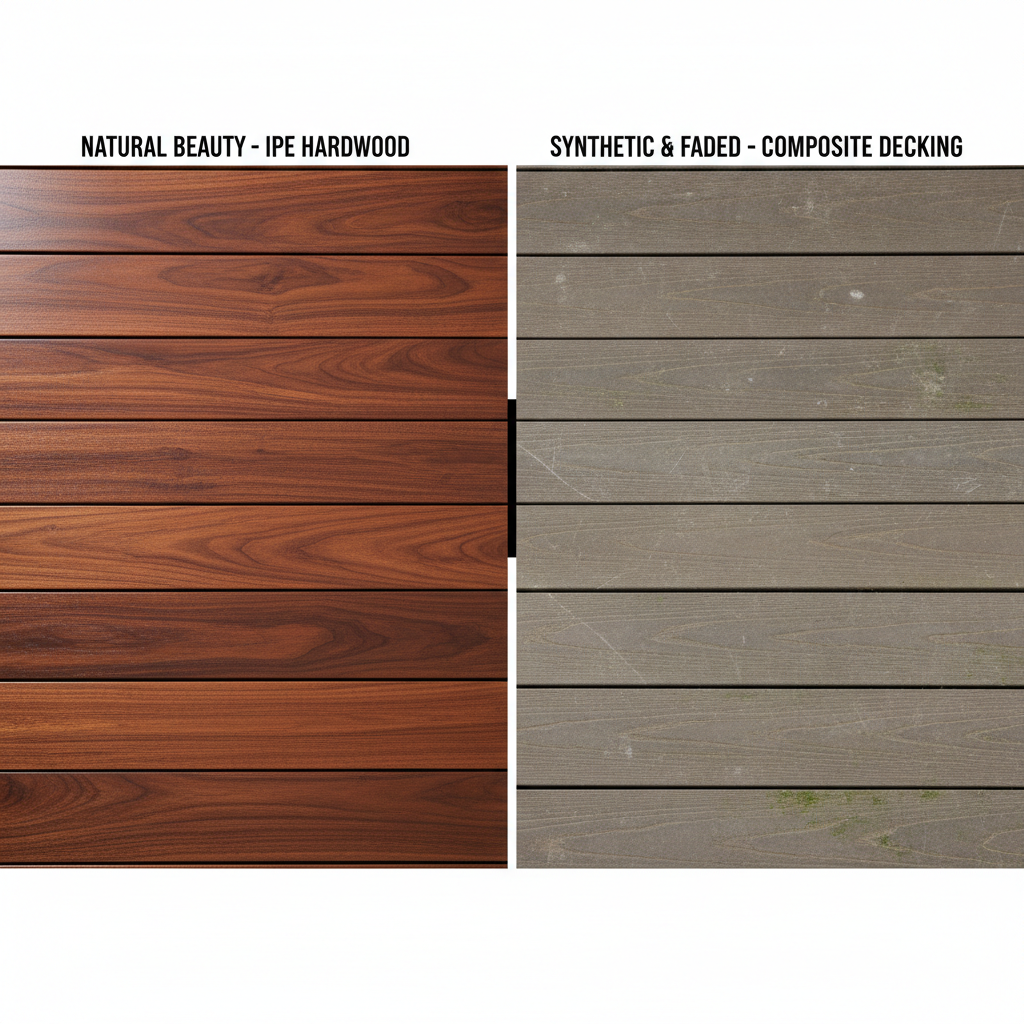
The Real Choice: Nature's Best vs. Engineered Plastics
When evaluating premium decking, homeowners eventually face the ultimate choice: a natural exotic hardwood like Ipe, or a high-end composite/PVC product like Trex®. While marketing brochures promise "zero maintenance" and "lifetime warranties," the real-world experience of living with these materials over 10, 20, or 30 years tells a very different story.
Trex® is synonymous with composite decking. They pioneered the category and dominate the market. Their primary pitch is low maintenance—no sanding, staining, or painting required. However, 'low maintenance' is not 'no maintenance,' and what you save in annual oiling, you often pay for in thermal expansion, heat retention, and a product life that eventually requires replacement and disposal.
Ipe (pronounced EE-pay), also known as Brazilian Walnut, is one of the densest, hardest woods on the planet. It carries a Class A fire rating (the same as concrete and steel), naturally resists rot, decay, and insects without chemical treatments, and can last upwards of 75 years. Trex®, on the other hand, is a manufactured product made from plastics, wood fibers, or pure PVC, heavily reliant on its protective outer "cap" to survive the elements.
In this comprehensive guide, we will break down the true total cost of ownership, analyze the specific product lines of Trex®, examine real photos of how these materials age, and provide a definitive recommendation for your investment.
Decoding the Trex® Product Lines
Not all Trex® boards are created equal. Manufacturers segment their products into "Good, Better, Best" tiers. Here is how they stack up against a single, uncompromising standard: Ipe.
Trex® Transcend® (Premium)
Trex's top-tier line. It features a thicker cap, deeper wood-grain patterns, and a wider variety of colors. It is incredibly heavy and expensive, often costing as much or more than natural Ipe per linear foot.
vs Ipe Reality Check
At $10-$14 per linear foot, Transcend® is priced like a luxury hardwood. Yet, it gets hotter in direct sun, generally cannot be refinished when deeply scratched, and carries a manufactured aesthetic compared to real Ipe.
Trex® Enhance® / Select® (Budget to Mid-Range)
These lines are lighter, feature scalloped (hollowed-out) bottoms to save on material costs, and have shallower grain patterns that repeat frequently.
vs Ipe Reality Check
While cheaper upfront than Ipe ($4-$7/LF), scalloped boards use less material and may feel different underfoot depending on joist spacing and installation. They look noticeably artificial compared to natural wood, and the 25-year warranty decreases over time.
The Hidden Realities of Composite & PVC Decking
Heat Retention
Surface temperatures of darker composite decking in direct sun can exceed 140°F in certain climates, which may be uncomfortable for bare feet. Actual temperatures vary by color, airflow, and regional conditions. Dense hardwoods such as Ipe typically cool down faster than plastic-based decking once shaded, though surface temperatures vary based on color and exposure.
Damage & Repairability
When Ipe gets scratched by patio furniture or a dog's claws, you can simply lightly sand and re-oil the spot. It looks brand new. Most capped composites/PVC aren't designed to be sanded/refinished; deep gouges or melt damage usually require replacing the board.
Thermal Expansion & Contraction
Composite/PVC boards generally have higher thermal movement than dense hardwoods, requiring temperature-dependent gapping. Ipe is comparatively stable, though all wood experiences seasonal movement. Over time, constant thermal movement in synthetics can stress fasteners and create gaps at butt joints.
Brand-Specific Concerns
Earlier generations of composite decking (including legacy Trex® products) were the subject of litigation related to surface mold and degradation. Trex® states that its modern capped products were engineered to address those concerns. However, if the plastic shell is pierced, scratched, or compromised, the inner core can be exposed to moisture. Furthermore, Trex® warranties typically exclude labor and disposal, leaving you with a significant bill if a full replacement becomes necessary outside of material warranty coverage.
Total Cost of Ownership (TCO) Model
Evaluating a deck's true cost over 30 years requires considering different potential scenarios. While natural Ipe's costs are largely predictable maintenance, composite decking can vary wildly depending on its performance over time.
Scenario A
No Replacement Needed
Both decks perform well for 30 years without requiring board replacement. Costs are limited to initial installation and routine cleaning/maintenance.
Scenario B
Partial Material Replacement
Ipe requires sanding and refinishing. The composite deck requires partial replacement of damaged or degraded boards outside of labor warranty coverage.
Scenario C
Full Tear-Out & Rebuild
The deck reaches the end of its useful life and requires complete replacement. Labor and disposal costs are paid by the homeowner.
*TCO Analysis Assumptions: Based on a standard 300 sq ft deck. Initial costs include national average professional labor and premium materials. Maintenance costs factor in $150-$200/yr for cleaning solutions/oil (Ipe) and $50-$100/yr for specialized composite cleaners. Scenarios B and C illustrate potential outcomes if surface degradation or structural movement occurs outside of labor warranty coverage.
Technical Specifications: Ipe vs Trex®
| Feature | Ipe Hardwood | Trex® |
|---|---|---|
| Material Composition | 100% Solid Tropical Hardwood | Recycled plastic film and wood sawdust |
| Janka Hardness | 3,680 lbf (Incredibly hard) | N/A (Soft plastic shell, scratches easily) |
| Heat Retention | Disperses heat naturally; generally safe for bare feet | Darker colors can exceed 130-140°F in direct summer sun |
| Fire Rating | Class A (when installed according to tested assemblies) | Most Trex® decking products are listed as Class C flame spread under ASTM E84 |
| Lifespan | Multi-decade service life | 25-50 Year Limited Warranty |
| Repairability | Can be sanded and refinished | Deep gouges generally require board replacement |
The Environmental Truth
Composite companies like Trex® heavily market themselves as "green" because they use recycled plastics (like grocery bags) and reclaimed sawdust. While recycling plastic is good, end-of-life recycling options for wood-plastic composites are limited in many regions, so a significant portion may still end up in landfills.
When a composite deck reaches the end of its life, the fused mixture of plastic and wood fiber can be difficult to separate.
When legally harvested under regulated forestry practices, Ipe can be sourced from managed forests operating under Brazilian environmental law and Lacey Act compliance. Ipe is a natural wood product and biodegrades at end of life; any applied finishes and metal fasteners are separate waste streams.
Final Verdict & Recommendation
If your budget restricts you to Trex® Enhance®, you are trading a solid board feel and aesthetics for a lower price point. However, if you are considering Trex® Transcend®, you are trading the proven longevity of natural wood for a manufactured aesthetic. Trex® Transcend® costs just as much as genuine Ipe, but delivers a manufactured aesthetic, higher heat retention in direct sun, and is covered by a limited warranty period of 25–50 years depending on product line. Choose Ipe for a naturally durable deck that will outlast your mortgage.
If you are building a "forever home" or want to maximize the ROI on your property, there is no substitute for authentic Ipe. The initial material cost of premium Trex® lines often meets or exceeds the cost of Ipe, yet it delivers a synthetic aesthetic, potential heat retention issues, and if significant degradation occurs outside labor coverage, replacement can be costly.
Our Recommendation: Choose Ipe. Accept that you may need to oil it once a year if you want to keep the rich brown color, or do nothing and let it age into a stunning, maintenance-free silver patina. Either way, you will have a deck that outperforms Trex® in key areas such as repairability, fire rating, and long-term refinishing flexibility.
The Warranty Trap
Even with an "approved" warranty claim, you're still paying for teardown and rebuild—and labor costs far exceed material costs.
What the "Trex® Warranty" Actually Means
Trex® offers 25 to 50-year limited residential warranties depending on the product line. However, warranty coverage may decrease over time depending on the product line and year of purchase. If a deck requires replacement under warranty, you generally only receive a material credit. Most importantly, Trex® typically excludes labor and disposal costs. If you need a replacement, you will typically pay out-of-pocket to tear out the old deck, dispose of the material, and reinstall the new boards.
What's Typically NOT Covered (Even When Claim is Approved):
- Tear-out and demolition
- Disposal of failed material
- Labor to reinstall
- Permits and inspections
- Fasteners and railings
- Downtime and inconvenience
Typical Deck Cost Breakdown
Reality: If a Trex® deck fails, the material credit often covers only a fraction of the total rebuild cost.
When Trex® Fails
Warranty Approved
Manufacturer replaces boards (often pro-rated)
You Still Pay
Thousands in tear-out and labor costs
Teardown & Rebuild
1-2 weeks of disruption for a typical deck
Result
Rebuild costs more than original materials
Time-Consuming Process
- • Photo documentation required
- • Proof of purchase needed
- • Long review timelines
- • Deck unusable during process
Pro-Rated Coverage
- • Coverage value declines with age
- • Partial material credit only
- • Shipping may not be covered
- • Older decks get less value
Full Rebuild Risk
- • Boards don't match exactly
- • Railings must be removed
- • Fasteners often incompatible
- • Entire deck needs rebuild
The Ipe Difference: No Warranty Games
Natural Durability = No Claims
Ipe doesn't rely on warranty fine print. It simply doesn't fail systemically like synthetic materials.
Gradual, Predictable Aging
Natural hardwood ages gracefully. No sudden surface failures, mold outbreaks, or flaking.
Repairable Without Teardown
Individual boards can be refinished or replaced without demolishing the entire deck.
Up to 75+ Year Lifespan
Proven over centuries in harsh climates. No fine print, just performance.
With Ipe, you invest in longevity upfront—not in warranty claims and rebuilds later.
Addressing Trex®'s Claims About Ipe
It's common for composite manufacturers to make direct comparisons to hardwood. Here is the context you need to evaluate these claims. The following comparisons are based on publicly available manufacturer statements and warranty documents as of 2026.
"Harvesting virgin wood contributes to deforestation… significantly impacting the environment."
The Reality
This frames environmental impact one-directionally. It ignores that legally harvested and FSC-certified tropical hardwoods exist. Wood is renewable and stores carbon, whereas composite manufacturing involves petrochemical processing, plastic lifecycle emissions, and challenging end-of-life disposal.
"Wood decks can cost up to $400 annually for maintenance... With Trex®, maintenance costs are as low as $10 a year"
The Reality
Stating '$10 a year' is highly optimistic marketing framing assuming basic soap and water cleaning with no mold remediation or specialized cleaners. Conversely, '$400 annually' for wood is an upper bound (like hiring a professional) rather than a typical DIY maintenance cost.
"Wood's 15-year average lifespan"
The Reality
This statement is overgeneralized and misleading. It lumps pressure-treated pine, softwoods, and tropical hardwoods into one number. While treated pine may last 10-20 years, Ipe has a documented exterior service life of 40-75+ years.
"Trex® lasts decades… up to 50-year warranties — far outlasting wood’s 15-year average lifespan."
The Reality
This is an asymmetrical comparison that matches the maximum Trex® warranty (50 years) against the lowest wood lifespan estimate (15 years for pine). Properly maintained Ipe has demonstrated multi-decade service life that rivals or exceeds composite warranties.
"Cost Per Square Foot: Ipe $15–$22 vs Trex® $4.60–$13.60"
The Reality
These numbers are selective. Ipe pricing varies dramatically by thickness, grade, and market conditions, while premium Trex® lines (like Transcend®) often reach or exceed the upper end of their quoted range.
"No sanding, sealing, painting — ever"
The Reality
While composites don't need sealing, this is an absolute. Composites can scratch, stain, require specialized cleaning, or need full board replacement when damaged.
"SunComfortable™ products… can still get hot to the touch when direct sunlight and high temperatures converge"
The Reality
Trex®'s own fine print acknowledges that their boards can get hot. This contradicts their broader marketing tone; heat mitigation in composites is relative, and darker colors can still reach uncomfortable surface temperatures.
Frequently Asked Questions
It depends on the Trex® line. Ipe is generally more expensive than Trex® Enhance®, but often costs the same or less than Trex® Transcend® initially. When you factor in the multi-decade lifespan of Ipe versus the 25-50 year warranty limits of Trex®, Ipe often proves more economical over the long term.
Darker Trex® boards, like many composites, can retain significant heat. In direct summer sun, surface temperatures can exceed 140°F, which may be uncomfortable for bare feet. Ipe is dense but generally disperses heat differently, often feeling more manageable underfoot.
While minor scuffs on some composites might be blended with heat guns (a method often not officially endorsed), deep scratches or gouges in Trex® generally require full board replacement since you cannot sand the plastic cap. If you scratch an Ipe deck, you can lightly sand the spot and apply oil to restore it.
No decking is entirely maintenance-free. Trex® requires regular cleaning to prevent debris buildup and potential mold growth on the surface. While it doesn't require oiling like wood, neglecting basic cleaning can lead to stubborn stains.
Ready to explore Ipe decking?
Browse every ipe decking size, profile, and grade with live pricing.
Compare Ipe Against Other Brands
Disclaimer & Legal Notice
The information provided on this page, including pricing, warranties, product specifications, and legal history, is compiled from publicly available sources, manufacturer websites, consumer reviews, and public court records as of early 2026. While we strive to maintain accurate and up-to-date information, manufacturers frequently change product formulations, warranty terms, and pricing. Ipe Woods USA makes no guarantees regarding the absolute accuracy or current validity of third-party product specifications.
All brand names, product names, trademarks, and logos mentioned (including but not limited to Trex®, TimberTech®, AZEK®, Fiberon®, and MoistureShield®) are the property of their respective owners. Ipe Woods USA is an independent supplier of natural hardwood lumber and is not affiliated with, endorsed by, or sponsored by any of the composite or PVC decking manufacturers discussed.
References to class-action lawsuits, product failures, and warranty limitations are based on documented historical events and consumer reports. They are intended for educational and comparative purposes only. Consumers are strongly encouraged to conduct their own independent research, read complete manufacturer warranty documents, and consult with certified professionals before making any purchasing decisions.