.png?width=180&quality=75&format=webp)
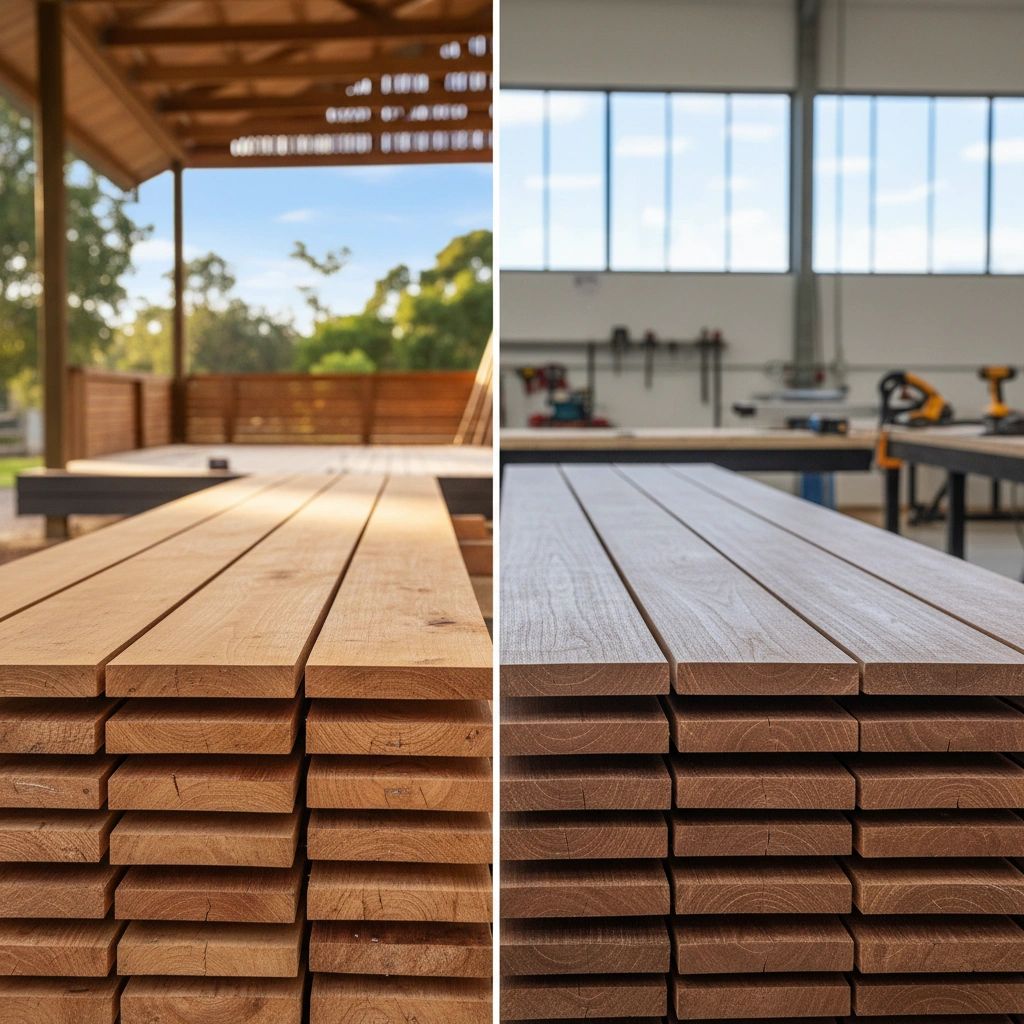
Air-Dried (AD) Or Kiln-Dried (KD) Hardwood Decking
Understanding the difference and choosing the right option for your project
Since there is no protection against direct sunlight when using Ipe outdoors, the closeness to excess moisture implies that an air-dried Ipe is the ideal wood.
Air-Dried (AD)
~18% moisture content
Air-dried Ipe prior to milling in South America is close to 18% moisture content. For exterior use, it is precisely what you will need for a quality and durable decking board.
Kiln-Dried (KD)
10-14% moisture content
Ipe is kiln-dried to 10-14% moisture content (not 6-8% like other woods). This level eliminates water without expelling bound water or solidifying the wood's cell walls, preventing surface cracking.
Standard Ipe Decking Processing
There is no doubt concerning the use of Ipe for decking is the most common use. When Ipe is used for decking it has E4E (eased four edges) and is S4S (smoothed four sides), this has to be performed on the four sides and four edges of Ipe respectively to curb splintering and sharp edges for the decking use. This leaves a little edge curved to make it softer to the touch.
Based on the manner in which our clients want to use Ipe for decking, it is sometimes required to groove for clip fasteners. However, in most cases, such tasks are what we do with the wood before shipment. Even pregrooved ipe has eased-edges. You can request square-edge but that requires an additional milling procedure.
History of AD Ipe and KD Ipe
It used to be that all woods were always air-dried. But currently, the rate of production is alarming, and the seasoning process for lumber is at a faster rate. Hence, the process of kiln-drying has now included decking products for exterior use.
The most important point to note here is that in contrast to the lumber used for interior work, Ipe is not kiln-dried to 6-8% moisture content; instead, it is kiln-dried to 10-14% moisture content. Why? Because such a level is enough for eliminating the water without expelling the bound water or solidifying the wood's cell walls. Since Ipe is so extremely dense, kilning to a lower level comes with the risk of surface cracking. This is when the outside dries at a faster pace than the inside of the wood.
Weather Adaptability & Moisture Balance
Humid Climate
Air-dried boards are closer to stable moisture content in humid environments. They work hand-in-hand with weather changes such as high moisture during the rainy season.
Dry/Desert Climate
A deck can be substantially heated by day-long, direct sunshine, which will expel moisture out, and result in warping. Proper acclimation and ventilation are key.
While a wood that can withstand change and all looks like an excellent material, it can be a nightmare — the reason being that you can hardly go against moisture change in the outside environment, particularly a deck which stands as the cruelest place for wood. On the other hand, the most prudent choice is a flexible board that can work hand-in-hand with weather changes.
One cogent point to consider is the intensity of sunshine being received by the deck. You can win this situation by putting down a drier board and properly acclimating first, then focusing on ventilation, and gap spacing. As long as it is at a stable point with the immediate environment, the decking will concede and recede moisture as the season changes.
The Critical Importance of Acclimation
For Both AD and KD: Proper Acclimation is Essential
To prevent the effect of various weather conditions such as the sun, temperature changes, or rain hitting hard on your board, it is best advised to properly acclimate. Regardless of which one you purchase, you will need to review our installation instructions with the most important part being the acclimation of the wood to your specific environment.
Allow the boards to acclimatize. In a case where your deck is in the desert during the summer, naturally, the weather will reduce the moisture content of the decking to a stable point. In such cases, gap-spacing selection and focusing to stabilize the airflow will assist your course significantly more than lower moisture content.
For this reason, air-dried decking is commonly found since it is mostly believed that high moisture content is closer to a stable point in almost every part of the USA. But for either KD or AD you need to acclimate properly. For those staying in dry climates or under open southern exposed decks, you will hear people (even knowledgeable contractors) say that kiln-dried decking should be used. However, this is simply not true — they are the exact same thing if allowed to acclimate properly.
Calling AD and KD "The Same Thing"?
Calling the two kinds of material the same thing is a fault of the lumber industry. Kiln-dried lumber usually has 6-8% moisture content, and as mentioned earlier, roughly sawed Ipe is usually moved at this level too. To differentiate between the 10-14% Ipe and the decking air-dried with higher moisture content you can use a moisture meter.
They are not made the same but they can end up nearly identical during acclimation.
With this knowledge, you can save some money as AD is a little less expensive than KD. When you choose between the two products as they are both excellent choices for dry or humid weather.
Key Takeaways
For Outdoor Decking
Air-dried (18% moisture) is the default and most cost-effective choice. It's what we recommend for 99% of outdoor projects.
Acclimation is Critical
Whether you choose AD or KD, proper acclimation to your local climate is absolutely essential for success. Allow 7-14 days minimum.
Both Work When Done Right
With proper installation and acclimation, both AD and KD will perform identically. Save money with AD unless you have a specific reason to choose KD.
Quick Decision Guide
✓ Choose Air-Dried (AD) If:
- • You're building an outdoor deck (most common)
- • You want to save money (AD is less expensive)
- • Your location has normal to high humidity
- • You're in most parts of the USA
✓ Choose Kiln-Dried (KD) If:
- • You're doing an interior flooring project
- • You're in an extremely dry climate (desert regions)
- • You want slightly faster acclimation time
- • You specifically need lower initial moisture content
Our Ipe Inventory
At Ipe Woods USA, we move a large amount of Ipe in different sizes meant for either decking boards, posts, balusters or joists. We run both air-dried Ipe decking and kiln-dried Ipe decking.
Without a doubt, for as long as possible, both the kiln-dried and the air-dried decking will remain in a similar and overlapping range with Ipe.
Be sure to specify AD or KD on your invoice if you have a preference. Otherwise, we'll ship the most appropriate option for your location.
IMPORTANT LEGAL STUFF
The information contained on this site is meant to be used as a reference only and is not to be interpreted as a guarantee of any sort.
To properly install your deck, we recommend that you work with an experienced professional. All information on the site is only generalized recommendations. We are not and will not be held liable for improper installation, for any reason, including but not limited to information inaccuracy.
Again, consult a professional for all things related to installation.