.png?width=180&quality=75&format=webp)
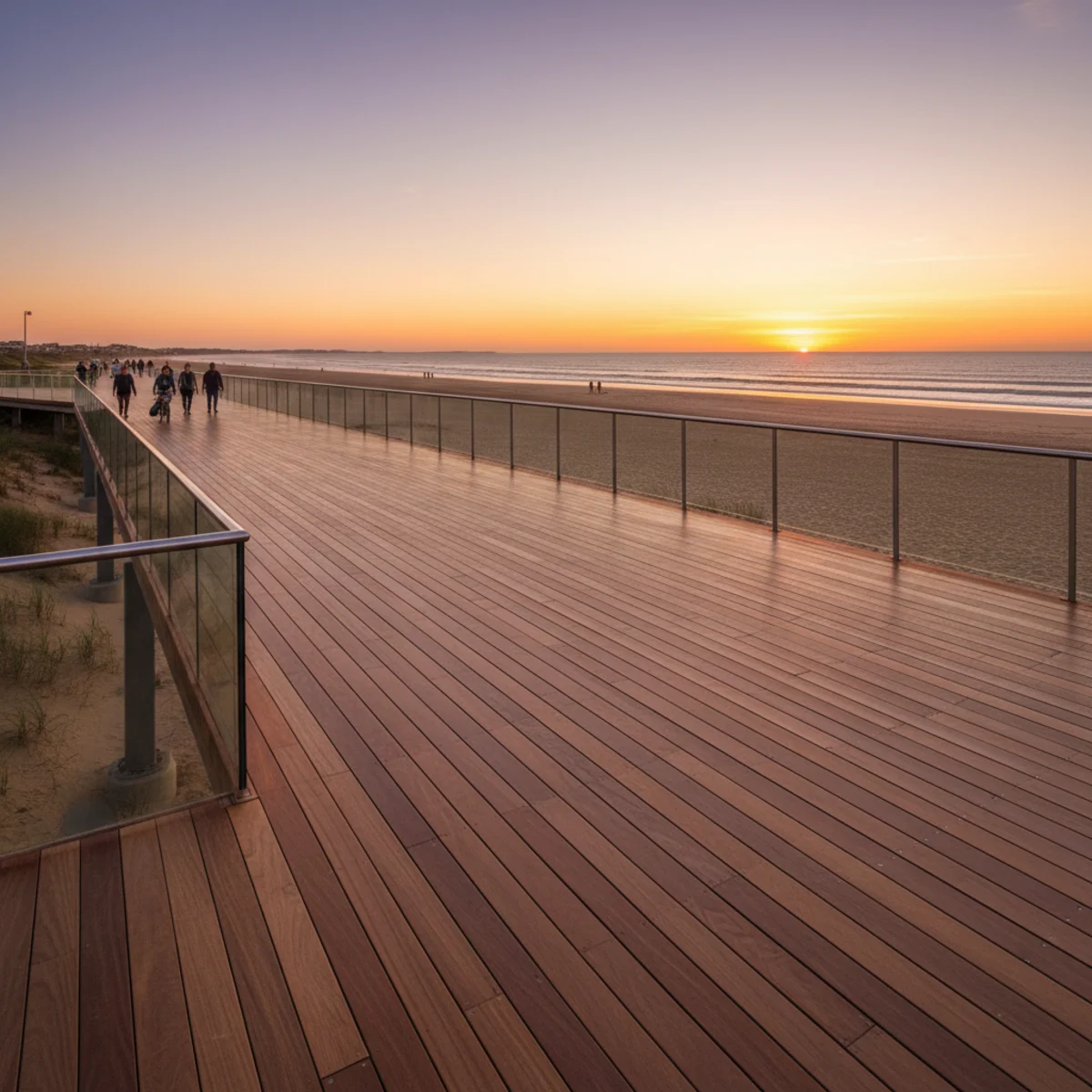
Tigerwood Boardwalk Lumber
A boardwalk that becomes a destination — Tigerwood's dramatic striped grain creates a luxury walking experience for resorts, hotels, golf courses, and high-end commercial properties.
Janka Hardness
2,160 lbf
Boardwalk Lifespan
Up to 40+ years
Fire Rating
Class A
ADA Slip Resistance
Compliant
Why Choose Tigerwood for Boardwalks
Tigerwood boardwalk lumber creates a walking surface that becomes a design destination in its own right. The dramatic orange-brown base with bold dark tiger stripes transforms a functional boardwalk into a luxury visual experience — ideal for resort properties, hotels, golf courses, upscale commercial developments, and any project where the boardwalk itself should be part of the attraction. No other boardwalk material delivers this level of visual distinction.
At 2,160 Janka — over six times harder than pressure-treated pine — Tigerwood boardwalk decking handles substantial public foot traffic for up to 40+ years. The splinter-free surface is ADA compliant and barefoot-safe, with good wet slip resistance for outdoor applications. Like all tropical hardwoods, Tigerwood requires no chemical treatment, meaning zero leaching into surrounding landscapes, gardens, or water features.
Tigerwood boardwalk lumber is especially effective for resort and hospitality paths where the boardwalk is part of the guest experience. The striped grain at ground level creates a rhythmic visual pattern underfoot that's unlike anything composite, concrete, or standard wood can provide. For destinations where aesthetics drive foot traffic and brand perception, a Tigerwood boardwalk makes a statement that reflects premium quality.
Also used for residential decking → Tigerwood Decking
Also used for dock decking → Tigerwood Dock Decking
Recommended Tigerwood Boardwalk Sizes
5/4x6
Standard boardwalk boards for public paths, nature trails, and promenades.
Shop 5/4x62x6
Commercial and municipal boardwalks with heavy traffic and vehicle loads.
Shop 2x61x6
Lighter-duty nature trail and park path boardwalks.
Shop 1x65/4x4
Narrow walkways, garden paths, and connecting paths.
Shop 5/4x4Boardwalk Applications for Tigerwood
Beach Boardwalks
Beachfront boardwalks, beach access paths, and coastal walks.
Nature Trails
Park and preserve nature trail boardwalks through wetlands and forests.
Promenades
Urban waterfront promenades, riverwalk paths, and downtown pedestrian walkways.
Resort Boardwalks
Hotel, resort, and golf course pathways and pool surrounds.
Park & Recreation
Public park paths, playground and rec area connections.
Wetland Crossings
Elevated boardwalks over marshes, swamps, and ecologically sensitive areas.
Tigerwood Boardwalk Specifications
| Botanical Name | Astronium spp. |
| Common Names | Tigerwood, Goncalo Alves, Jobillo |
| Janka Hardness | 2,160 lbf |
| Density | 56 lbs/ft³ |
| Durability Class | Class 1-2 |
| Fire Rating | Class A (ASTM E84) |
| Rot Resistance | Very Good |
| Insect Resistance | Very Good |
| ADA Slip Resistance | Meets requirements when maintained |
| Expected Boardwalk Lifespan | Up to 40+ years |
| Color (Fresh) | Orange-brown with dramatic dark tiger stripes |
| Color (Weathered) | Silver-gray patina |
| Chemical Treatment Required | No |
| Recommended Sizes | 5/4x6, 2x6, 1x6, 5/4x4 |
| Origin | Central & South America (Brazil, Mexico) |
Boardwalk Installation & Engineering Notes
Joist spacing: 16" OC for 5/4, 12" OC for 2x. Orient boards to maximize the visual impact of the striped grain pattern across the walking surface. Leave 3/16" gaps. 316 SS fasteners for coastal, 304 for inland. Pre-drill all holes. Seal cut ends. Acclimate 7-14 days.
Tigerwood Boardwalk vs. The Alternatives
| Feature | Tigerwood | PT Pine | Composite | Concrete | Fiberglass |
|---|---|---|---|---|---|
| Boardwalk Lifespan | Up to 40+ yrs | 10-15 yrs | 15-20 yrs | 30+ yrs | 25-30 yrs |
| Lifecycle Cost (50 yr) | Lowest | Highest (3-4 replacements) | High (2-3) | Moderate | Moderate |
| ADA Slip Resistance | Excellent | Poor when worn | Moderate | Moderate | Good |
| Splinter-Free | Yes | No — worsens | Yes | N/A | Yes |
| Barefoot Safety | Excellent | Poor | Hot in sun | Rough | Rough |
| Chemical Leaching | None | Yes — CCA/ACQ | Microplastics | Alkaline | None |
| Environmental Permitting | Easiest | Complex | Moderate | Complex | Moderate |
| Aesthetics | Premium natural | Basic | Uniform plastic | Industrial | Industrial |
Tigerwood Boardwalk vs Pressure-Treated Boardwalk
PT boardwalks are basic and utilitarian. Tigerwood creates a luxury walking experience that reflects property quality. Tigerwood lasts up to 40+ years vs 10-15 for PT, is splinter-free, chemical-free, and dramatically more beautiful.
Tigerwood Boardwalk vs Ipe Boardwalk
Ipe is harder and longer-lasting with a uniform chocolate-brown color. Tigerwood offers a dramatic visual statement that Ipe doesn't. For resort and hospitality boardwalks where aesthetics are the primary driver, Tigerwood is the more distinctive choice.
Learn moreTigerwood Boardwalk FAQ
Explore More Boardwalks
All Hardwood Boardwalks
Browse all species
Ipe Boardwalks
Shop ipe boardwalks
Cumaru Boardwalks
Shop cumaru boardwalks
Garapa Boardwalks
Shop garapa boardwalks
Massaranduba Boardwalks
Shop massaranduba boardwalks
Red Balau Boardwalks
Shop red balau boardwalks
About Tigerwood Wood
Species information & properties
All Hardwood Species
Compare all species