.png?width=180&quality=75&format=webp)
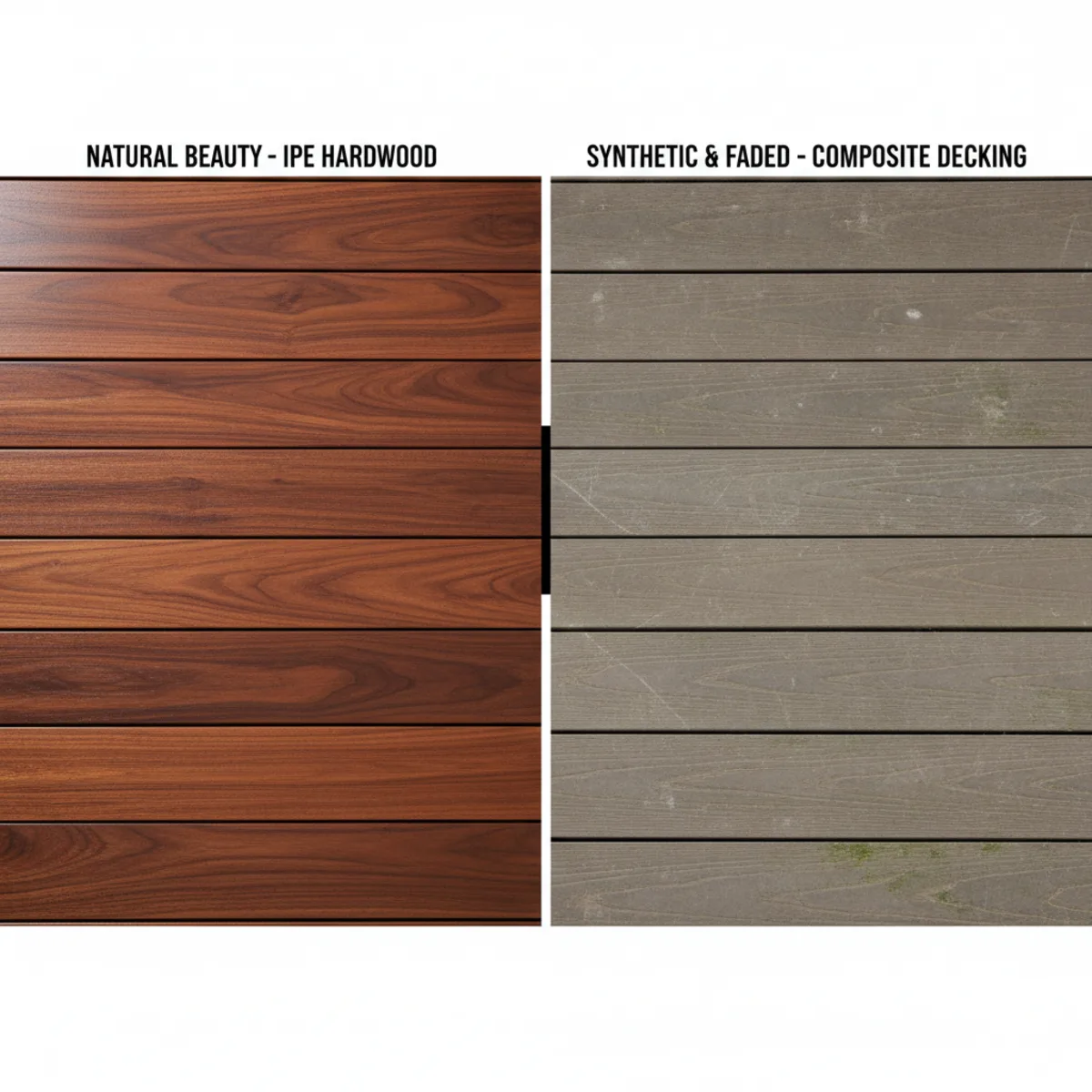
The Real Choice: Nature's Best vs. Engineered Plastics
When evaluating premium decking, homeowners eventually face the ultimate choice: a natural exotic hardwood like Ipe, or a high-end composite/PVC product like TimberTech®. While marketing brochures promise "zero maintenance" and "lifetime warranties," the real-world experience of living with these materials over 10, 20, or 30 years tells a very different story.
TimberTech® (owned by The AZEK® Company) positions itself as the technological leader in the composite decking space. Their PRO® and EDGE® lines use a composite core wrapped in a highly engineered polymer cap. They heavily market their '4-sided capping' to prevent moisture intrusion. While it is generally considered a step up from older composite generations, it remains fundamentally a composite of wood fiber and plastic polymer matrix subject to thermal expansion, heat retention, and permanent damage if scratched.
Ipe (pronounced EE-pay), also known as Brazilian Walnut, is one of the densest, hardest woods on the planet. It carries a Class A fire rating (the same as concrete and steel), naturally resists rot, decay, and insects without chemical treatments, and can last upwards of 75 years. TimberTech®, on the other hand, is a manufactured product made from plastics, wood fibers, or pure PVC, heavily reliant on its protective outer "cap" to survive the elements.
In this comprehensive guide, we will break down the true total cost of ownership, analyze the specific product lines of TimberTech®, examine real photos of how these materials age, and provide a definitive recommendation for your investment.
Decoding the TimberTech® Product Lines
Not all TimberTech® boards are created equal. Manufacturers segment their products into "Good, Better, Best" tiers. Here is how they stack up against a single, uncompromising standard: Ipe.
TimberTech® PRO® (Legacy®, Reserve®, Terrain®)
Their premium composite line featuring 4-sided capping. It boasts deep texturing and complex color blending to mimic real wood.
vs Ipe Reality Check
Pricing is extremely high ($10-$15/LF). You are paying exotic hardwood prices for a plastic imitation. Heavier embossing can hold more dust/debris in the grain compared with smoother hardwood surfaces, which may increase cleaning effort in some environments.
TimberTech® EDGE® (Prime®, Premier®)
Their entry-level option, capped only on 3 sides to cut costs. It features simpler colors and less dramatic grain patterns.
vs Ipe Reality Check
Because EDGE® boards are capped on three sides, the underside is less protected than fully wrapped products; if the core is exposed (cuts, damage, improper installation), moisture absorption is more possible than with fully capped boards. Ipe is a solid, very dense hardwood with excellent natural resistance to moisture and decay.
The Hidden Realities of Composite & PVC Decking
Heat Retention
Surface temperatures of darker composite decking in direct sun can exceed 140°F in certain climates, which may be uncomfortable for bare feet. Actual temperatures vary by color, airflow, and regional conditions. Dense hardwoods such as Ipe typically cool down faster than plastic-based decking once shaded, though surface temperatures vary based on color and exposure.
Damage & Repairability
When Ipe gets scratched by patio furniture or a dog's claws, you can simply lightly sand and re-oil the spot. It looks brand new. Most capped composites/PVC aren't designed to be sanded/refinished; deep gouges or melt damage usually require replacing the board.
Thermal Expansion & Contraction
Composite/PVC boards generally have higher thermal movement than dense hardwoods, requiring temperature-dependent gapping. Ipe is comparatively stable, though all wood experiences seasonal movement. Over time, constant thermal movement in synthetics can stress fasteners and create gaps at butt joints.
Brand-Specific Concerns
While modern composite formulations have improved, some homeowners have historically reported issues with fading or surface degradation over long timeframes. A major consideration is the warranty: while they offer long-term material warranties, labor and disposal are often excluded or limited. If a board requires replacement outside of the labor coverage window, you are responsible for demolition, disposal, and re-installation labor costs—which typically exceed the cost of the materials.
Total Cost of Ownership (TCO) Model
Evaluating a deck's true cost over 30 years requires considering different potential scenarios. While natural Ipe's costs are largely predictable maintenance, composite decking can vary wildly depending on its performance over time.
Scenario A
No Replacement Needed
Both decks perform well for 30 years without requiring board replacement. Costs are limited to initial installation and routine cleaning/maintenance.
Scenario B
Partial Material Replacement
Ipe requires sanding and refinishing. The composite deck requires partial replacement of damaged or degraded boards outside of labor warranty coverage.
Scenario C
Full Tear-Out & Rebuild
The deck reaches the end of its useful life and requires complete replacement. Labor and disposal costs are paid by the homeowner.
*TCO Analysis Assumptions: Based on a standard 300 sq ft deck. Initial costs include national average professional labor and premium materials. Maintenance costs factor in $150-$200/yr for cleaning solutions/oil (Ipe) and $50-$100/yr for specialized composite cleaners. Scenarios B and C illustrate potential outcomes if surface degradation or structural movement occurs outside of labor warranty coverage.
Technical Specifications: Ipe vs TimberTech®
| Feature | Ipe Hardwood | TimberTech® |
|---|---|---|
| Material Core | Solid Brazilian Walnut | Recycled wood fibers mixed with plastic |
| Moisture Resistance | Naturally highly resistant to rot and water decay | Capped composite relies on the cap for surface protection; the core can absorb moisture if exposed |
| Thermal Expansion | Extremely minimal; joints stay tight | High; boards expand and contract daily, loosening fasteners |
| Fire Rating | Class A (Highest rating available) | Fire performance varies by product and assembly; check product documentation for the specific collection and local code requirements. |
| Aesthetic Aging | Ages into a beautiful silver patina (or stays brown with oil) | Composite appearance can change over time from UV and wear; the degree of fade is addressed through TimberTech's fade & stain warranty terms (product-specific). |
| Scratch Repair | Sandable and completely repairable | Permanent damage. Board must be replaced. |
The Environmental Truth
Composite companies like TimberTech® heavily market themselves as "green" because they use recycled plastics (like grocery bags) and reclaimed sawdust. While recycling plastic is good, end-of-life recycling options for wood-plastic composites are limited in many regions, so a significant portion may still end up in landfills.
When a composite deck reaches the end of its life, the fused mixture of plastic and wood fiber can be difficult to separate.
When legally harvested under regulated forestry practices, Ipe can be sourced from managed forests operating under Brazilian environmental law and Lacey Act compliance. Ipe is a natural wood product and biodegrades at end of life; any applied finishes and metal fasteners are separate waste streams.
Final Verdict & Recommendation
TimberTech® PRO® is an over-engineered solution to a problem nature already solved. At $10 to $15 per linear foot, buying TimberTech® means you are paying exotic luxury prices for a factory-extruded plastic polymer. Ipe offers identical or better pricing, significantly higher durability, a Class A fire rating, and the undeniable prestige of owning real, rare, exotic hardwood. Don't settle for the imitation when the real thing costs the same.
If you are building a "forever home" or want to maximize the ROI on your property, there is no substitute for authentic Ipe. The initial material cost of premium TimberTech® lines often meets or exceeds the cost of Ipe, yet it delivers a synthetic aesthetic, potential heat retention issues, and if significant degradation occurs outside labor coverage, replacement can be costly.
Our Recommendation: Choose Ipe. Accept that you may need to oil it once a year if you want to keep the rich brown color, or do nothing and let it age into a stunning, maintenance-free silver patina. Either way, you will have a deck that outperforms TimberTech® in key areas such as repairability, fire rating, and long-term refinishing flexibility.
The Warranty Trap
Even with an "approved" warranty claim, you're still paying for teardown and rebuild—and labor costs far exceed material costs.
What the "TimberTech® Warranty" Actually Means
TimberTech® offers a Limited Replacement Labor Warranty (typically 2–7 years) when products are installed by a TimberTech® registered contractor and the warranty is properly registered; coverage length varies by contractor level and the product system purchased. Outside that window (or without qualifying installation/registration), warranty remedies are generally materials-focused and homeowners may be responsible for tear-out and labor. Furthermore, warranty remedies can be limited and may vary over time by product and warranty type; homeowners should review the specific warranty document for proration and remedy details.
What's Typically NOT Covered (Even When Claim is Approved):
- Tear-out and demolition
- Disposal of failed material
- Labor to reinstall
- Permits and inspections
- Fasteners and railings
- Downtime and inconvenience
Typical Deck Cost Breakdown
Reality: If a TimberTech® deck fails, the material credit often covers only a fraction of the total rebuild cost.
When TimberTech® Fails
Warranty Approved
Manufacturer replaces boards (often pro-rated)
You Still Pay
Thousands in tear-out and labor costs
Teardown & Rebuild
1-2 weeks of disruption for a typical deck
Result
Rebuild costs more than original materials
Time-Consuming Process
- • Photo documentation required
- • Proof of purchase needed
- • Long review timelines
- • Deck unusable during process
Pro-Rated Coverage
- • Coverage value declines with age
- • Partial material credit only
- • Shipping may not be covered
- • Older decks get less value
Full Rebuild Risk
- • Boards don't match exactly
- • Railings must be removed
- • Fasteners often incompatible
- • Entire deck needs rebuild
The Ipe Difference: No Warranty Games
Natural Durability = No Claims
Ipe doesn't rely on warranty fine print. It simply doesn't fail systemically like synthetic materials.
Gradual, Predictable Aging
Natural hardwood ages gracefully. No sudden surface failures, mold outbreaks, or flaking.
Repairable Without Teardown
Individual boards can be refinished or replaced without demolishing the entire deck.
Up to 75+ Year Lifespan
Proven over centuries in harsh climates. No fine print, just performance.
With Ipe, you invest in longevity upfront—not in warranty claims and rebuilds later.
Addressing TimberTech®'s Claims About Ipe
It's common for composite manufacturers to make direct comparisons to hardwood. Here is the context you need to evaluate these claims. The following comparisons are based on publicly available manufacturer statements and warranty documents as of 2026.
"Ipe will never perform as well as engineered decking"
The Reality
The phrase 'will never perform as well' is an absolute and unqualified statement. Performance depends on the metric (hardness, repairability, thermal behavior, resistance to rot). Wood can be refinished, whereas composites cannot. Hardwoods resist heat differently than plastics. While wood naturally ages, dismissing its performance universally lacks nuance.
"Moisture will eventually break down Ipe's natural resistance"
The Reality
Ipe has an incredibly high natural resistance to rot and decay. Its heartwood contains natural extractives that deter decay fungi far better than many softwoods. While any material can degrade under persistent saturation over many years, Ipe does not inevitably succumb to mold or rot under typical deck exposure.
"UV rays cause Ipe to fade/dull rapidly"
The Reality
Ipe transitions to a beautiful silver-gray patina without maintenance—a known aesthetic change, not a structural failure. Graying does not indicate reduced structural performance. Framing this natural aging characteristic as a 'defect' is misleading.
"Ipe's environmental cost is 'wholly unsustainable'"
The Reality
This claim ignores legal, certified sourcing pathways such as FSC or other sustainably managed plantations that mitigate environmental concerns. Using 'wholly unsustainable' without qualification overstates the case.
"No wood means better performance and sustainability"
The Reality
Wood is biodegradable and renewable. PVC is recyclable in some programs but not universally. Equating 'no wood' with better sustainability oversimplifies environmental science, as life-cycle impacts depend on transportation, maintenance, and disposal routes.
"Ipe cost will grow throughout its lifetime"
The Reality
This portrays maintenance as an escalating burden, but it depends heavily on owner preferences. If a natural silver patina is desired, maintenance is minimal. If maintaining the original brown color with periodic oiling is preferred, the costs are predictable and manageable. It should be framed as a potential ongoing cost, not a guaranteed escalating liability.
Frequently Asked Questions
TimberTech® PRO® does an impressive job mimicking wood from a distance. However, up close and underfoot, it feels like plastic. The repeating grain patterns become obvious on large decks. Ipe is 100% unique—no two boards are identical.
Ipe is incredibly dense and requires pre-drilling and specialized saw blades. TimberTech® cuts like butter. However, deck framing and labor are essentially the same. Most professional deck builders charge similar labor rates for both.
If a hot coal from a grill or fire pit drops on TimberTech®, it will instantly melt the plastic cap, leaving a permanent black crater that cannot be fixed. Ipe has a Class A fire rating; a coal might leave a minor scorch mark that can literally be sanded away in 30 seconds.
Ready to explore Ipe decking?
Browse every ipe decking size, profile, and grade with live pricing.
Compare Ipe Against Other Brands
Disclaimer & Legal Notice
The information provided on this page, including pricing, warranties, product specifications, and legal history, is compiled from publicly available sources, manufacturer websites, consumer reviews, and public court records as of early 2026. While we strive to maintain accurate and up-to-date information, manufacturers frequently change product formulations, warranty terms, and pricing. Ipe Woods USA makes no guarantees regarding the absolute accuracy or current validity of third-party product specifications.
All brand names, product names, trademarks, and logos mentioned (including but not limited to Trex®, TimberTech®, AZEK®, Fiberon®, and MoistureShield®) are the property of their respective owners. Ipe Woods USA is an independent supplier of natural hardwood lumber and is not affiliated with, endorsed by, or sponsored by any of the composite or PVC decking manufacturers discussed.
References to class-action lawsuits, product failures, and warranty limitations are based on documented historical events and consumer reports. They are intended for educational and comparative purposes only. Consumers are strongly encouraged to conduct their own independent research, read complete manufacturer warranty documents, and consult with certified professionals before making any purchasing decisions.