.png?width=180&quality=75&format=webp)
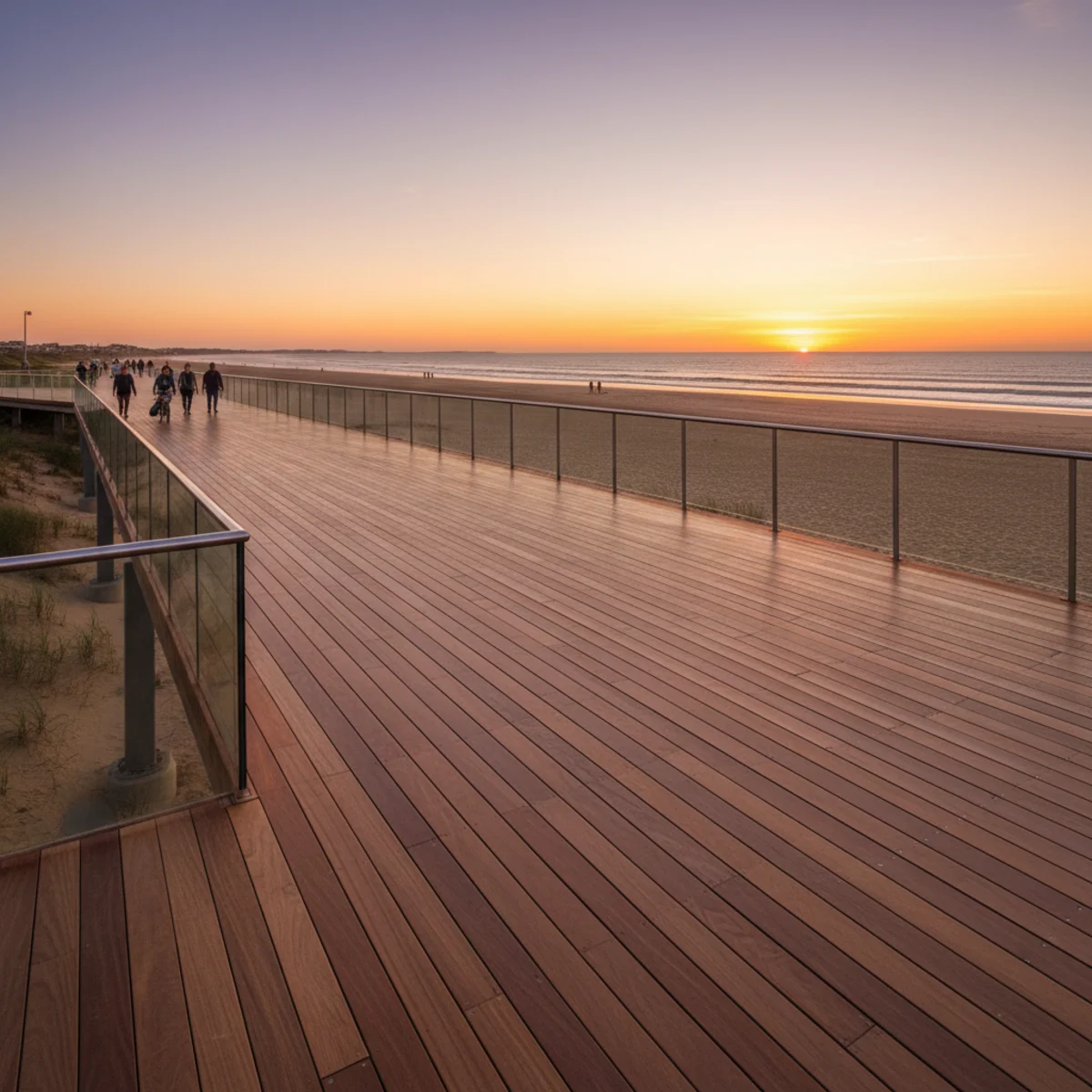
Ipe Boardwalk Lumber
The industry standard for boardwalks — proven on Atlantic City and Coney Island. up to 75+ year lifespan, ADA compliant, zero chemical leaching into wetlands and waterways.
Janka Hardness
3,680 lbf
Boardwalk Lifespan
Up to 75+ years
Fire Rating
Class A
ADA Slip Resistance
Compliant
Why Choose Ipe for Boardwalks
Ipe boardwalk lumber is the proven standard for public infrastructure boardwalks across America. Atlantic City's legendary boardwalk, Coney Island's iconic promenade, and hundreds of municipal boardwalks from the Gulf Coast to New England use Ipe because no other material delivers up to 75+ years of splinter-free, maintenance-free performance under millions of footsteps per year. When a city engineer or parks director specifies boardwalk lumber, Ipe is the benchmark all others are measured against.
At 3,680 Janka hardness — the highest of any commercially available boardwalk wood — Ipe boardwalk decking resists the constant abrasion of heavy foot traffic that destroys softer woods in a decade. Dense tropical hardwood naturally meets ADA friction coefficient requirements for slip resistance when wet, providing safe footing on beach boardwalks, wetland crossings, and waterfront promenades where moisture is constant. The surface stays splinter-free for the life of the installation — critical for public spaces where barefoot pedestrians and liability are concerns.
Ipe boardwalk lumber requires zero chemical treatment, which means zero CCA, ACQ, or copper leaching into wetlands, marshes, nature preserves, and waterways. This dramatically simplifies environmental permitting for boardwalks through ecologically sensitive areas — a major practical advantage for municipalities and parks departments. Class A fire rating meets wildland-urban interface codes for boardwalks in fire-prone regions.
The lifecycle cost argument closes the deal for municipal decision-makers: one Ipe boardwalk outlasts 4-5 pressure-treated boardwalks over the same 75-year period. Each PT replacement cycle costs the municipality not just materials and labor, but also public disruption, permits, environmental review, and lost revenue from closed facilities. An Ipe boardwalk eliminates all of that — build it once, and it serves generations.
Also used for residential decking → Ipe Decking
Also used for dock decking → Ipe Dock Decking
Recommended Ipe Boardwalk Sizes
5/4x6
Standard boardwalk boards for public paths, nature trails, and promenades.
Shop 5/4x62x6
Commercial and municipal boardwalks with heavy traffic and vehicle loads.
Shop 2x61x6
Lighter-duty nature trail and park path boardwalks.
Shop 1x65/4x4
Narrow walkways, garden paths, and connecting paths.
Shop 5/4x4Boardwalk Applications for Ipe
Beach Boardwalks
Beachfront boardwalks, beach access paths, and coastal walks.
Nature Trails
Park and preserve nature trail boardwalks through wetlands and forests.
Promenades
Urban waterfront promenades, riverwalk paths, and downtown pedestrian walkways.
Resort Boardwalks
Hotel, resort, and golf course pathways and pool surrounds.
Park & Recreation
Public park paths, playground and rec area connections.
Wetland Crossings
Elevated boardwalks over marshes, swamps, and ecologically sensitive areas.
Ipe Boardwalk Specifications
| Botanical Name | Handroanthus spp. |
| Common Names | Ipe, Brazilian Walnut, Lapacho |
| Janka Hardness | 3,680 lbf |
| Density | 69 lbs/ft³ |
| Durability Class | Class 1 |
| Fire Rating | Class A (ASTM E84) |
| Rot Resistance | Excellent |
| Insect Resistance | Excellent |
| ADA Slip Resistance | Meets requirements when maintained |
| Expected Boardwalk Lifespan | Up to 75+ years |
| Color (Fresh) | Olive-brown to dark chocolate-brown |
| Color (Weathered) | Silver-gray patina |
| Chemical Treatment Required | No |
| Recommended Sizes | 5/4x6, 2x6, 1x6, 5/4x4 |
| Origin | Central & South America (Brazil, Bolivia, Peru) |
Boardwalk Installation & Engineering Notes
Joist spacing: 16" OC for 5/4 boards, 12" OC for 2x boards and heavy commercial boardwalks — verify with structural engineer for public projects. Board direction perpendicular to travel for best visual effect and structural span. Leave 3/16" gaps standard; slightly wider for beach boardwalks to allow sand drainage. 316 stainless steel fasteners mandatory for coastal; 304 acceptable inland. ADA compliance: consistent surface, no gaps wider than 1/2", dense hardwood naturally meets friction coefficient requirements. Helical pile substructure for wetland boardwalks minimizes environmental disturbance. Seal all cut ends. Acclimate 7-14 days on-site.
Ipe Boardwalk vs. The Alternatives
| Feature | Ipe | PT Pine | Composite | Concrete | Fiberglass |
|---|---|---|---|---|---|
| Boardwalk Lifespan | Up to 75+ yrs | 10-15 yrs | 15-20 yrs | 30+ yrs | 25-30 yrs |
| Lifecycle Cost (50 yr) | Lowest | Highest (3-4 replacements) | High (2-3) | Moderate | Moderate |
| ADA Slip Resistance | Excellent | Poor when worn | Moderate | Moderate | Good |
| Splinter-Free | Yes | No — worsens | Yes | N/A | Yes |
| Barefoot Safety | Excellent | Poor | Hot in sun | Rough | Rough |
| Chemical Leaching | None | Yes — CCA/ACQ | Microplastics | Alkaline | None |
| Environmental Permitting | Easiest | Complex | Moderate | Complex | Moderate |
| Aesthetics | Premium natural | Basic | Uniform plastic | Industrial | Industrial |
Ipe Boardwalk vs Pressure-Treated Boardwalk
PT boardwalks last 10-15 years and require 4-5 replacement cycles over the lifespan of one Ipe boardwalk. Each replacement means public closure, construction disruption, environmental review, and new permitting. PT splinters badly, becomes dangerously slippery, and leaches chemicals into wetlands. Ipe eliminates all of these issues for up to 75+ years.
Ipe Boardwalk vs Composite Boardwalk
Composite gets dangerously hot in sun — a serious issue on exposed boardwalks. It sags under heavy foot traffic, sheds microplastics into sensitive habitats, and lasts only 15-20 years. Ipe stays moderate temperature, handles any traffic load, and is 100% natural with zero microplastic pollution.
Ipe Boardwalk vs Cumaru Boardwalk
Cumaru delivers comparable boardwalk performance at 30-40% lower cost. For municipalities with tight budgets, Cumaru is the smart alternative. Choose Ipe for maximum lifespan and the proven track record that satisfies engineers and specification committees.
Learn moreIpe Boardwalk FAQ
Explore More Boardwalks
All Hardwood Boardwalks
Browse all species
Cumaru Boardwalks
Shop cumaru boardwalks
Tigerwood Boardwalks
Shop tigerwood boardwalks
Garapa Boardwalks
Shop garapa boardwalks
Massaranduba Boardwalks
Shop massaranduba boardwalks
Red Balau Boardwalks
Shop red balau boardwalks
About Ipe Wood
Species information & properties
All Hardwood Species
Compare all species