.png?width=180&quality=75&format=webp)
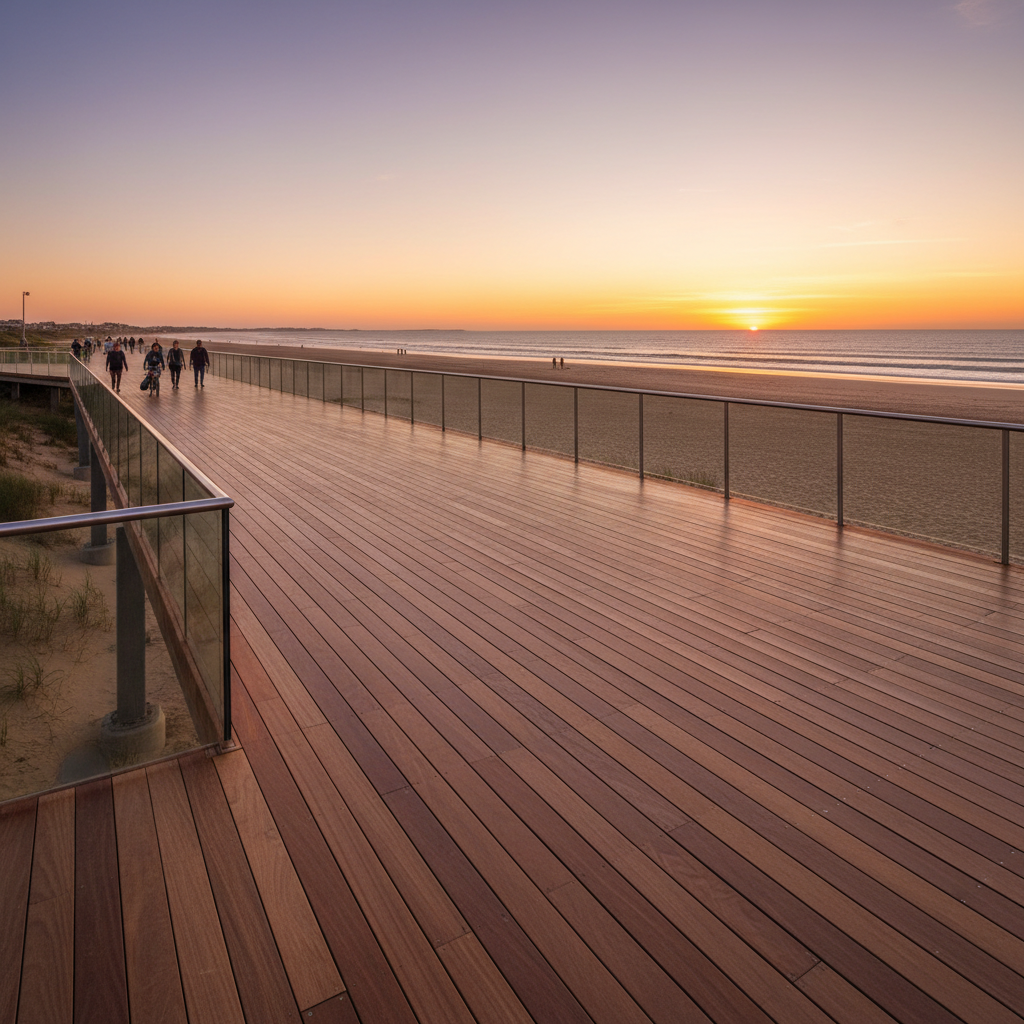
How to Build a Hardwood Boardwalk
Step-by-step construction guide for tropical hardwood boardwalks. Covers planning, ADA compliance, structural considerations, joist spacing, fasteners, gapping, and long-term maintenance.
Looking to shop for boardwalk lumber? Visit our Boardwalk Lumber page for species options and live pricing.
Boardwalk Construction Quick Reference
Joist Spacing
16" OC (5/4x6)
24" OC for 2x6
Fasteners
316 Stainless
Coastal; 304 for inland
Board Gap
3/16" – 1/4"
ADA: ≤1/2" perp. to travel
Acclimation
5–7 Days
On-site before install
ADA & Structural Considerations
ADA Compliance
- Gaps ≤ 1/2" perpendicular to travel direction
- Smooth, splinter-free surface (hardwood excels here)
- Maximum running slope: 1:20 (5%)
- Maximum cross slope: 1:48 (2%)
- Flush transitions between surfaces
Structural Notes
- Tropical hardwoods weigh 52–69 lbs/ft³ — heavier than softwoods
- Substructure must be engineered for the increased load
- Get a structural engineer for elevated designs
- Check environmental permits for wetland/coastal zones
- Design for maintenance vehicle loads if applicable
Step-by-Step Boardwalk Construction
Same principles apply whether you're building a municipal promenade or a backyard garden path.
1Plan & Permit
Check local building codes, ADA requirements, and environmental permits (especially for wetland or coastal boardwalks). Tropical hardwoods are heavier than softwoods (52–69 lbs/ft³) — substructure must be engineered accordingly. Get a structural engineer for elevated designs.
2Acclimate Lumber On-Site
Stack boardwalk lumber with stickers (spacers) in a covered, ventilated area at the job site for 5–7 days before installation. This allows the wood to reach equilibrium moisture content and reduces post-installation movement.
3Set Joist Spacing
For 5/4x6 boards: 16" on center max. For 2x6 boards: 24" on center max. For 1x6 boards: 16" on center max. Use pressure-treated or naturally durable joists. Ensure all joists are level and properly shimmed.
4Pre-Drill All Screw Holes
Tropical hardwoods (Janka 1,600–3,540 lbf) cannot accept direct-driven fasteners. Pre-drill every screw hole with a countersink bit to prevent splitting and ensure a flush, snag-free walking surface — essential for ADA compliance.
5Use 316 Stainless Steel Fasteners
Salt air corrodes standard 304 stainless within years. All coastal boardwalk projects should use 316 marine-grade stainless steel screws and structural hardware. For freshwater or inland boardwalks, 304 stainless is acceptable.
6Maintain 3/16" to 1/4" Board Gaps
Proper gapping ensures drainage, promotes airflow under the boardwalk surface, and accommodates seasonal wood expansion. For ADA-accessible boardwalks, gaps must run perpendicular to travel and not exceed 1/2".
7Seal End Grain on Every Cut
Apply end-grain sealer (such as Anchorseal) immediately after cutting. This prevents moisture infiltration that causes checking and end-splitting — especially critical for boardwalk boards exposed to rain, humidity, and splash zones.
8Inspect & Maintain Annually
Check fasteners, board gaps, and structural connections annually. Clean with a deck cleaner or pressure washer on low setting. Reapply UV oil if maintaining color, or let it weather naturally to silver-grey.
Common Boardwalk Construction Mistakes
Skipping structural engineering
Fix: Tropical hardwoods are heavy. Always get an engineer for elevated boardwalks to spec pilings, joists, and connections.
Using standard steel fasteners
Fix: Salt air corrodes non-stainless fasteners. Use 316 SS for coastal, 304 SS for inland boardwalks.
Ignoring ADA gap requirements
Fix: Public boardwalks must have gaps ≤ 1/2" perpendicular to travel direction. Plan board orientation accordingly.
Not leaving expansion gaps
Fix: Leave 3/16"–1/4" gaps between boards for drainage and seasonal expansion.
Forgetting to seal end grain
Fix: Unsealed cuts absorb water and crack. Seal every cut immediately with end sealer (Anchorseal or equivalent).
Skipping acclimation
Fix: Install without acclimation and boards will gap or buckle as they adjust. Allow 5–7 days on-site.
Boardwalk Construction FAQ
Common questions about building hardwood boardwalks.
Disclaimer: This guide is for general informational purposes only. Boardwalk construction is subject to local building codes, ADA requirements, coastal zone regulations, environmental permitting, and structural engineering standards. Always consult a licensed structural engineer and local building authority before designing or constructing a boardwalk. Ipe Woods USA assumes no liability for design or construction decisions.