.png?width=180&quality=75&format=webp)
Why Choose Tigerwood for Siding & Cladding
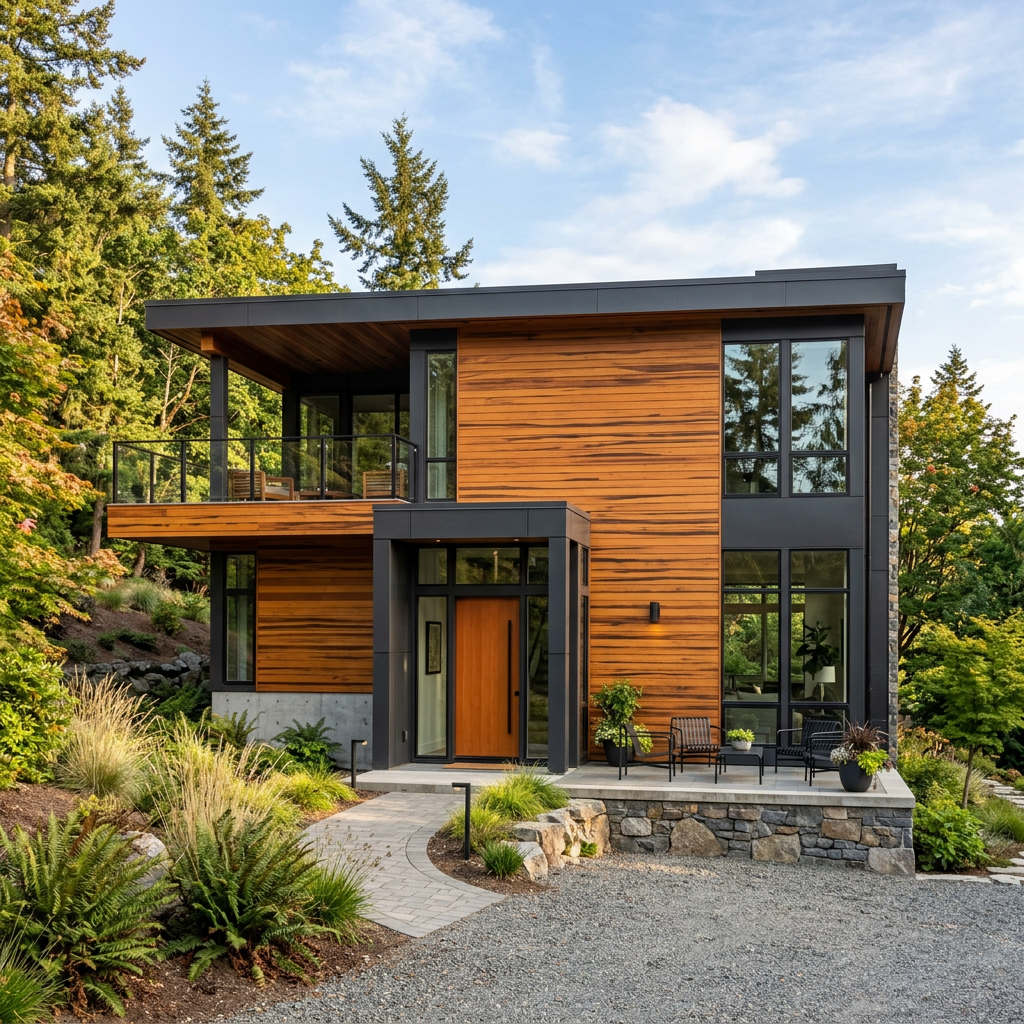
Tigerwood siding is the ultimate visual statement piece for exterior cladding. No other commercially available siding species offers the dramatic, eye-catching grain pattern of Tigerwood — bold orange-brown tones interlaced with dark brown to nearly black streaks that resemble tiger stripes. When installed on an exterior wall, Tigerwood wood siding creates a facade that draws attention from the street and becomes the defining architectural feature of any home or commercial building.
Beyond its show-stopping appearance, Tigerwood cladding delivers serious durability for an exterior application. At 2,160 lbf on the Janka scale, Tigerwood siding is substantially harder than domestic woods like cedar (350 lbf), redwood (450 lbf), and even white oak (1,360 lbf). The wood naturally resists rot, decay, and insect damage for up to 40+ years without chemical treatment, and carries a Class A fire rating for building code compliance.
Tigerwood shiplap siding is particularly popular for accent wall applications — a single exterior wall or entryway clad in Tigerwood creates an immediate focal point that elevates the entire property. Even homeowners who choose a different primary siding material often specify Tigerwood for high-visibility accent sections. The dramatic stripe pattern works exceptionally well with modern, contemporary, and transitional architectural styles where bold material choices complement clean design lines.
The color evolution of Tigerwood is part of its charm. Fresh-milled boards display the most vivid orange and dark-stripe contrast. Over the first year, the stripes mellow and the overall tone deepens, creating a rich patina that's uniquely Tigerwood. Oiling preserves the vibrant contrast, while natural weathering produces a silver-gray surface where the stripe pattern remains faintly visible — a subtle texture that many architects find appealing.
Tigerwood exterior cladding pairs beautifully with neutral materials — concrete, glass, blackened steel, and white stucco all serve as excellent backdrops that let the wood's natural pattern take center stage. For rainscreen installations, the open-joint aesthetic of Tigerwood creates a modern, high-end facade with excellent ventilation and moisture management.
Siding Profiles Available in Tigerwood
Overlapping boards with a distinctive shadow line. Classic exterior look for traditional and modern facades.
Best for: Traditional facade, accent walls
Interlocking boards for a seamless, flush surface. Excellent weather protection with a refined appearance.
Best for: Soffits, porch ceilings, protected walls
Tigerwood Siding Specifications
| Botanical Name | Astronium spp. |
| Common Names | Tigerwood, Goncalo Alves, Jobillo |
| Janka Hardness | 2,160 lbf |
| Density | 56 lbs/ft³ |
| Durability Class | Class 1-2 |
| Fire Rating | Class A (ASTM E84) |
| Rot Resistance | Very Good |
| Insect Resistance | Very Good |
| Expected Lifespan (exterior) | Up to 40+ years |
| Color (Fresh) | Orange-brown with dark streaks (tiger stripes) |
| Color (Weathered) | Silver-gray patina |
| Available Thicknesses | 1x, 5/4 |
| Available Widths | 4", 6", 8" |
| Available Profiles | Shiplap, Tongue & Groove, Rainscreen, E4E |
| Origin | Central & South America (Brazil, Mexico) |
Available Tigerwood Siding Sizes
Installation Essentials for Tigerwood Siding
Install Tigerwood siding over a proper rainscreen or drainage plane. Pre-drill all screw holes with sharp carbide or HSS bits. Use stainless steel fasteners exclusively. For shiplap profiles, face-screw through the board; for T&G, blind-nail through the tongue where possible. Allow 7-14 days of on-site acclimation. Seal cut ends immediately with end-grain sealer. Both horizontal and vertical installation create stunning results — vertical runs particularly showcase the stripe pattern.
- Rainscreen/drainage plane — required behind all exterior siding
- Stainless steel fasteners — 316 grade for coastal environments
- Acclimate 7-14 days on-site before installation
- Seal cut ends immediately with end-grain sealer
How Tigerwood Siding Compares
Tigerwood Siding vs Ipe Siding
Ipe siding is nearly twice as hard as Tigerwood (3,680 vs 2,160 Janka) and lasts longer (up to 75+ years), but lacks Tigerwood's dramatic striped pattern. Choose Ipe for maximum durability or Tigerwood for visual impact.
Learn more about Ipe SidingTigerwood Siding vs Cedar Siding
Cedar siding is dramatically less durable (350 vs 2,160 Janka) and cannot match Tigerwood's striking visual pattern. Tigerwood lasts 3-4 times longer and creates a one-of-a-kind facade.
Tigerwood Siding vs Cumaru Siding
Cumaru siding is harder (3,330 vs 2,160 Janka) with warm uniform tones. Tigerwood wins on aesthetics with its signature striped grain — ideal for accent walls and statement facades.
Learn more about Cumaru SidingTigerwood Siding FAQ
All Tigerwood Siding Sizes & Profiles
Every available tigerwood siding product — click to view pricing and details.