.png?width=180&quality=75&format=webp)
Why Choose Ipe for Deck Railing
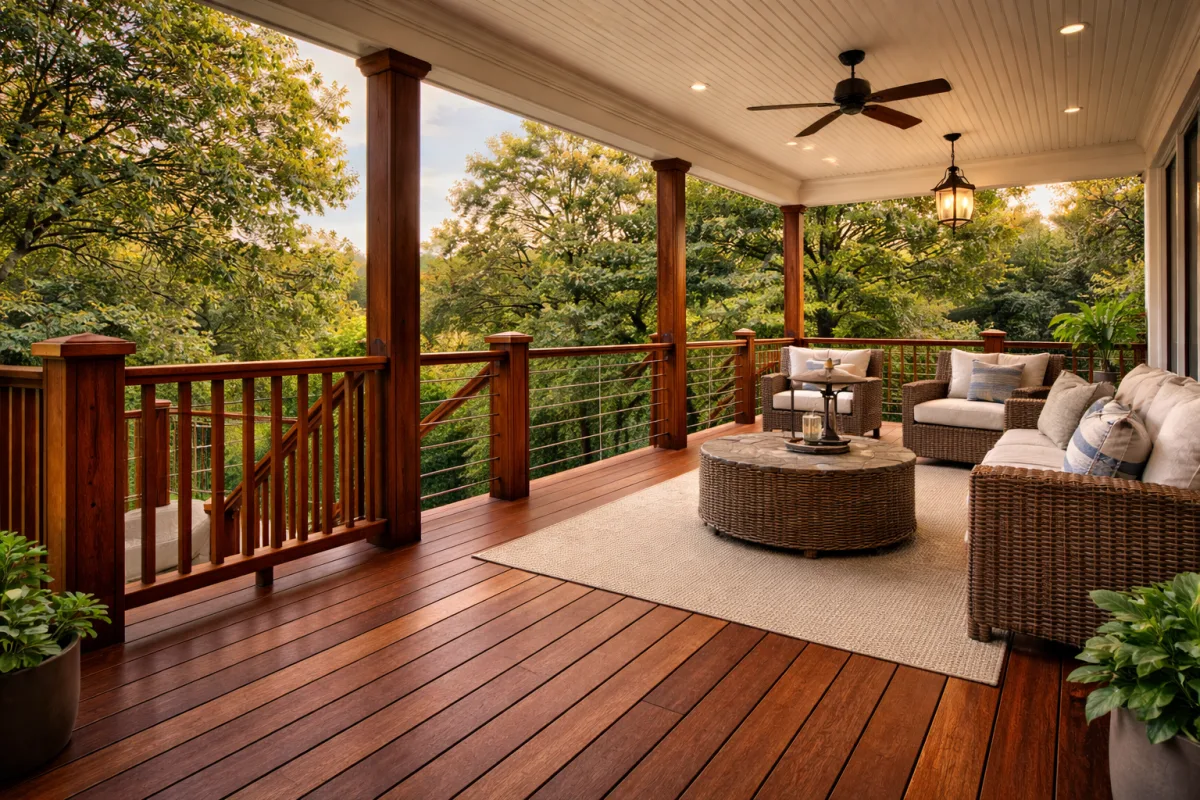
An Ipe deck railing is the natural completion of any Ipe deck project. When you've invested in the world's hardest decking, matching Ipe railing — posts, rails, and balusters in the same species — creates a cohesive design that flows seamlessly from the deck surface up through the perimeter. The color, grain, and weathering pattern match perfectly, giving the entire structure a unified, architect-designed appearance.
Beyond aesthetics, Ipe wood railing delivers unmatched structural confidence for a safety-critical application. At 3,680 Janka hardness, Ipe railing posts and rails provide exceptional rigidity and load resistance. Railing is a structural system — it must resist leaning forces, lateral impact, and decades of exposure without loosening, warping, or weakening. Ipe's ironwood density ensures every railing component stays tight, straight, and solid for up to 75+ years.
Brazilian walnut railing also wins on daily tactile experience. Unlike aluminum railing that's cold to the touch in winter and scorching in summer, or cable railing that's purely visual, an Ipe handrail is warm, smooth, and comfortable to grip in every season. For a component that people touch every time they use the deck or stairs, this matters more than most homeowners realize until they experience the difference.
Ipe deck railing resists rot, insects, and decay naturally — no painting, no rust, no corrosion, no maintenance required. The rich chocolate-brown tones weather to silver-gray alongside your deck, or maintain the original color with UV oil. Class A fire rating adds safety for railing near structures. For the homeowner who wants the best wood for deck railing without compromise, Ipe is the definitive answer.
Complete your deck with matching railing → Shop Ipe Decking
Build Your Ipe Railing System
Posts
4x4 standard posts. 6x6 heavy/gate posts. Structural anchoring required — set into framing or surface-mount with hardware.
Sizes: 4x4, 6x6 (via Timbers/Fencing)
Shop Ipe Posts →Top Rail
2x4 standard top rail. 2x6 wide cap rail for a finished top edge. Continuous run for strength and graspable profile for stairs.
Sizes: 2x4, 2x6
Shop Ipe Rails →Balusters
2x2 standard vertical balusters. 1x1 slim balusters for a lighter, more open look. Space 4" max per code (sphere test).
Sizes: 1x1, 2x2
Shop Ipe Balusters →Bottom Rail
2x4 bottom rail keeps balusters aligned and secured at the base. Same material as top rail for consistent appearance.
Sizes: 2x4
Shop Ipe Rails →Need posts? Ipe 4x4 and 6x6 posts are available in our Fencing & Timbers categories. 4x4 Ipe Posts • 6x6 Ipe Posts • Browse All Timbers
Railing Styles You Can Build with Ipe
Vertical Baluster Railing
Classic look with vertical 2x2 or 1x1 balusters between posts, plus top and bottom rails. Meets all building codes for residential and commercial use.
Code: 4" max spacing between balusters (sphere test)
Components: 4x4 posts, 2x4 top & bottom rails, 2x2 or 1x1 balusters, optional 2x6 cap rail
Horizontal Rail Railing
Modern look with horizontal 2x2 or 2x4 boards running between posts. Clean, contemporary aesthetic with strong visual lines.
Note: Check local codes — some jurisdictions restrict horizontal infill (climbability concern)
Components: 4x4 posts, horizontal 2x2 or 2x4 infill, optional 2x6 cap rail
Ipe Railing Specifications
| Botanical Name | Handroanthus spp. |
| Common Names | Ipe, Brazilian Walnut, Lapacho |
| Janka Hardness | 3,680 lbf |
| Density | 69 lbs/ft³ |
| Durability Class | Class 1 |
| Fire Rating | Class A (ASTM E84) |
| Rot Resistance | Excellent |
| Insect Resistance | Excellent |
| Expected Lifespan | Up to 75+ years |
| Color (Fresh) | Olive-brown to dark chocolate-brown |
| Color (Weathered) | Silver-gray patina |
| Baluster Sizes | 1x1, 2x2 |
| Rail Sizes | 2x4, 2x6 |
| Post Sizes | 4x4, 6x6 (via Timbers/Fencing) |
| Origin | Central & South America (Brazil, Bolivia, Peru) |
Code & Installation Guide for Ipe Railing
Railing height: 36" residential, 42" commercial — verify local codes. Baluster spacing: 4" max opening (sphere test). Post spacing: 6' on center standard. Anchor posts through-bolt or surface-mount with structural hardware — proper post anchoring is critical for safety. Use stainless steel fasteners, pre-drill all holes with carbide bits. For stairs, handrail height is 34"-38" from stair nosing with a graspable profile. Match railing to your deck species and order from the same lot when possible for best color consistency.
Ipe Railing vs. The Alternatives
| Feature | Ipe | Aluminum | Cable | Composite | Vinyl |
|---|---|---|---|---|---|
| Appearance | Rich natural wood | Modern metallic | Minimal, open | Uniform plastic | Plastic |
| Lifespan | Up to 75+ yrs | 30+ yrs | 30+ yrs | 15-25 yrs | 15-20 yrs |
| Warmth/Feel | Warm to touch | Cold metal | N/A (cable) | Plastic feel | Plastic feel |
| Matches Deck | Yes — same species | No | No | No | No |
| Fire Rating | Class A | Non-combustible | Steel cables | Melts | Melts |
| Maintenance | Optional oil | None | Tension adjust | Wash | Wash |
| Customization | Fully custom | Limited | Limited | Limited | Limited |
Ipe Railing vs Aluminum Railing
Aluminum railing is cold, industrial, and cannot match your wood deck. Ipe railing is warm to the touch, matches Ipe decking perfectly, and provides the same structural strength with natural beauty. Both last up to 30+ years, but only Ipe creates a cohesive wood-on-wood design.
Ipe Railing vs Cable Railing
Cable railing provides minimal view obstruction but offers no warmth or wood beauty. An Ipe railing system with slim 1x1 balusters achieves a clean, open look while adding the natural grain and warmth that cables lack. Cables also require periodic tension adjustment — Ipe needs nothing.
Ipe Railing vs Cumaru Railing
Cumaru railing delivers 90% of Ipe's structural performance at a lower price. If budget matters more than maximum density, Cumaru is the smart alternative. Choose Ipe for the ultimate match to an Ipe deck or for maximum structural rating.
Learn moreIpe Railing FAQ
All Ipe Railing Sizes & Profiles
Every available ipe railing product — click to view pricing and details.
Explore More Railing
All Hardwood Railing
Browse all species
Cumaru Railing
Shop cumaru railing
Tigerwood Railing
Shop tigerwood railing
Garapa Railing
Shop garapa railing
Massaranduba Railing
Shop massaranduba railing
Red Balau Railing
Shop red balau railing
About Ipe Wood
Species information & properties
All Hardwood Species
Compare all species