.png?width=180&quality=75&format=webp)
Learn more about tigerwood wood — species properties, sustainability, and care guide.
Why Choose Tigerwood Decking
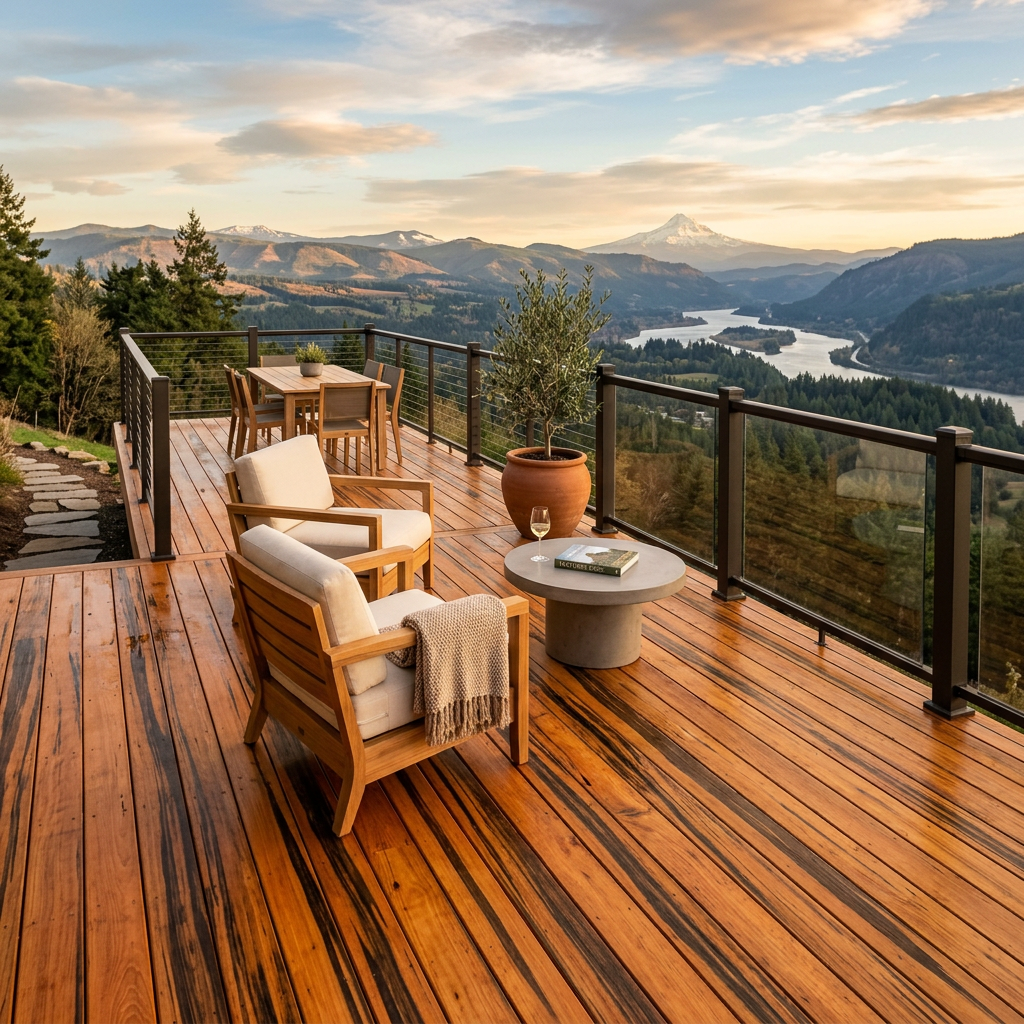
Tigerwood decking is the choice for homeowners and designers who want a deck that makes a statement. No other commercially available decking species offers the dramatic visual impact of Tigerwood's signature orange-brown base color streaked with dark, contrasting grain lines that resemble tiger stripes. Each board is unique, creating a one-of-a-kind deck surface that consistently draws compliments.
Beyond its striking appearance, Tigerwood delivers serious durability. At 2,160 lbf on the Janka hardness scale, it's substantially harder than domestic hardwoods like oak and significantly outperforms cedar, redwood, and all pressure-treated softwoods. Tigerwood carries a Class A fire rating and is rated Class 1-2 for durability, meaning it naturally resists rot, decay, and insect damage for decades without chemical treatment.
The color profile of fresh Tigerwood is unlike anything else in decking — rich orange-brown tones interlaced with dark brown to nearly black streaks that vary in intensity from board to board. This natural variation is the species' defining characteristic and is most pronounced when the wood is freshly milled or maintained with oil. Like all tropical hardwoods, untreated Tigerwood will eventually weather to a silver-gray patina, though the striped pattern remains faintly visible even after weathering.
Tigerwood decking is particularly popular for residential patios, outdoor dining areas, and pool surrounds where visual impact is paramount. It's also an excellent choice for small to medium decks where the dramatic grain pattern can be fully appreciated. Designers frequently specify Tigerwood for modern and contemporary homes where the bold aesthetic complements clean architectural lines.
Compared to composite decking, Tigerwood offers a natural beauty that no synthetic material can replicate. Against pressure-treated pine, the difference in both aesthetics and performance is substantial — Tigerwood lasts up to 40+ years versus 10-15 for treated lumber. Tigerwood is harvested from managed forests in Central and South America.
Tigerwood Decking Specifications
| Botanical Name | Astronium graveolens / Astronium lecointei |
| Common Names | Tigerwood, Goncalo Alves, Jobillo |
| Janka Hardness | 2,160 lbf |
| Density | 54 lbs/ft³ |
| Durability Class | Class 1-2 |
| Fire Rating | Class A (ASTM E84) |
| Rot Resistance | Very Good |
| Insect Resistance | Very Good |
| Expected Lifespan | Up to 40+ years |
| Color (Fresh) | Orange-brown with dark streaks (tiger stripes) |
| Color (Weathered) | Silver-gray patina |
| Available Thicknesses | 1x, 5/4, 2x |
| Available Widths | 4", 6" |
| Profiles | Pregrooved, Eased Edge (E4E), T&G |
| Origin | Central & South America (Brazil, Mexico) |
Available Tigerwood Decking Sizes
Installation & Maintenance Guide
Tigerwood Installation Tips
Tigerwood is dense and requires pre-drilling for all fasteners. Use stainless steel screws exclusively to prevent corrosion staining. The wood works well with hidden fastener systems in the pregrooved profile. Standard joist spacing of 16" on-center is recommended. Allow 3-5 days on-site acclimation before installation.
- Pre-drilling required for all screw holes
- 16" on-center joist spacing for standard residential installations
- Stainless steel fasteners required — no galvanized or zinc-coated
- Acclimate boards on-site before installation
Maintenance Options
Oil for color: Apply UV-protective oil annually to maintain the natural orange-brown with dark streaks (tiger stripes) tones. See our tigerwood deck maintenance guide for product recommendations.
Let it gray: No treatment needed — Tigerwood will weather to a beautiful silver-gray patina with zero impact on durability.
How Tigerwood Compares
Tigerwood vs Ipe
Ipe is nearly twice as hard as Tigerwood (3,680 vs 2,160 Janka) and lasts longer, but lacks Tigerwood's dramatic striped pattern. Choose Ipe for maximum durability or Tigerwood for visual impact.
Learn more about Ipe deckingTigerwood vs Cumaru
Cumaru is harder and more durable (3,330 Janka, up to 50+ year lifespan) but has a more uniform reddish-brown color. Tigerwood wins on aesthetics with its distinctive tiger-stripe grain.
Learn more about Cumaru deckingTigerwood vs Garapa
Garapa offers a lighter golden tone, while Tigerwood provides dramatic striped coloring. Both are excellent mid-range hardwoods, with Tigerwood being harder (2,160 vs 1,650 Janka).
Learn more about Garapa deckingTigerwood Decking FAQ
All Tigerwood Decking Sizes & Profiles
Every available tigerwood decking product — click to view pricing and details.
Explore More Decking
All Hardwood Decking
Browse all species
Ipe Decking
Shop ipe decking
Cumaru Decking
Shop cumaru decking
Garapa Decking
Shop garapa decking
Massaranduba Decking
Shop massaranduba decking
Red Balau Decking
Shop red balau decking
About Tigerwood Wood
Species information & properties
All Hardwood Species
Compare all species