.png?width=180&quality=75&format=webp)
Samples Are a Scammer's Best Friend
In the exotic hardwood industry, small wood samples are one of the easiest tools for dishonest sellers to misrepresent their product. Here's why: you can cut an impressive-looking sample from even a low-quality board. The best 4-inch section of a reject board can look better than a full-length premium board. This fundamental truth makes samples one of the least reliable ways to judge what your actual order will look like.
We understand that people want to see and feel the wood before committing to a purchase — that's completely reasonable. But unlike synthetic products that come off an assembly line looking identical, Ipe is a natural material with inherent variation in color, grain, and character. Every tree is different. Every board is unique. And a single small piece simply cannot represent the full range of what you'll receive in an order of real tropical hardwood.
This page exists to help you understand why samples can be misleading, how to protect yourself from deceptive sellers, and what actually matters when choosing an Ipe supplier.
A Sample Is Just One Piece of the Puzzle
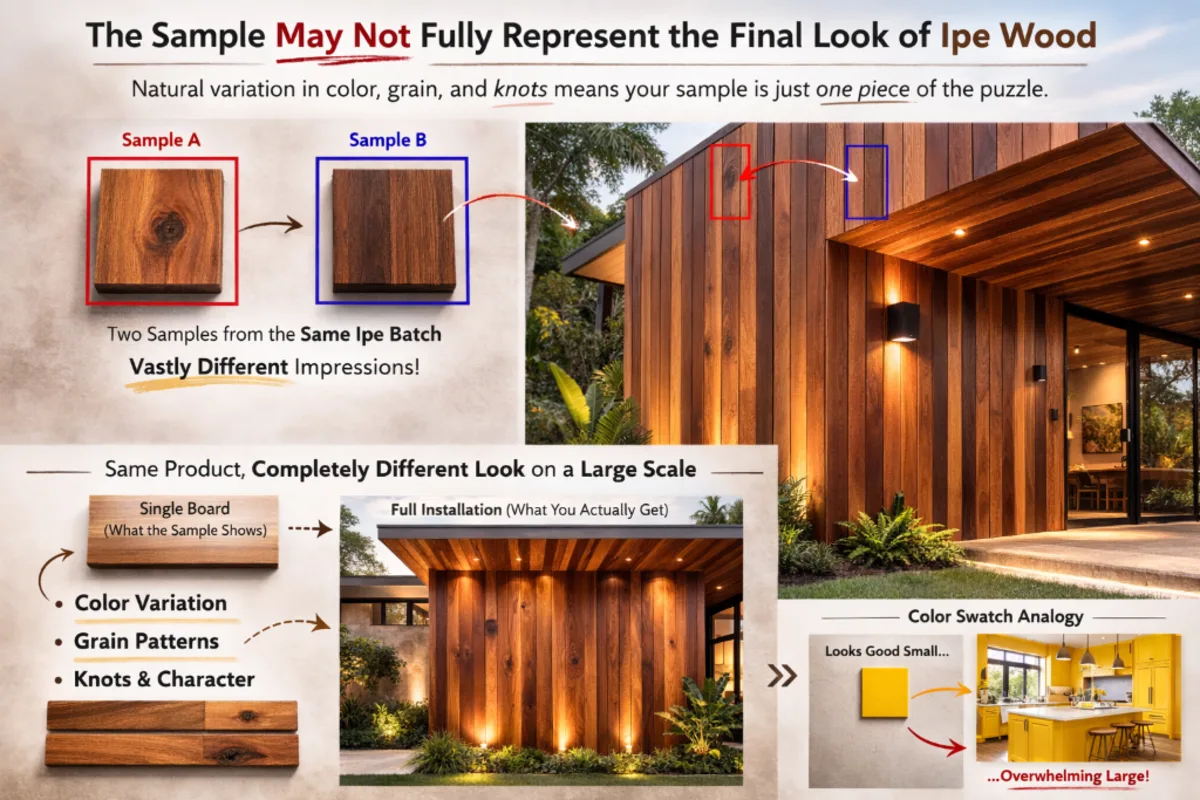
Two samples from the same batch can tell vastly different stories. Neither one represents the full picture.
Natural variation in color, grain, and knots means your sample is just one piece of the puzzle.
The Sample Is Too Small to Tell the Whole Story
Same product, completely different look at scale. What you see on a small board is never what you see on a full wall or deck.
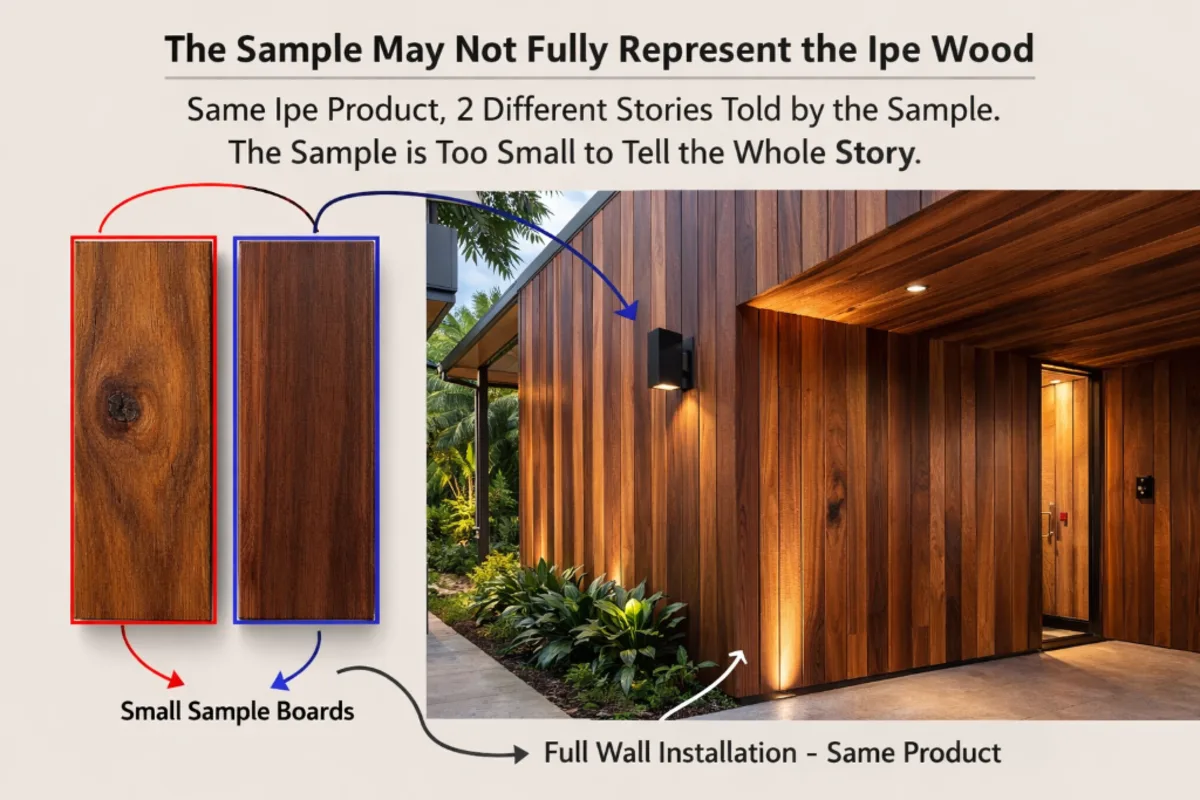
Same Ipe product, 2 different stories told by the sample. The sample is too small to tell the whole story.
Why Ipe Samples Can Be Misleading
Extreme Color Variation
Ipe ranges from olive-brown to deep reddish-brown — even boards from the same tree can look completely different. A sample shows one color point on a wide spectrum.
Grain & Character Differ Board to Board
Each board has unique grain patterns, mineral streaks, and natural character marks. A 4-inch sample captures a single snapshot, not the full story.
Cherry-Picking Is Unavoidable
Any company cutting a sample will naturally select an attractive piece. Even we wouldn't send the worst-looking section of a board — it's human nature. This means all samples skew toward the best.
Bad Actors Exploit This
Unscrupulous sellers send beautiful hand-picked samples, then ship lower-grade boards. Some even mix in reject lumber with good boards, leaving some customers satisfied and others feeling cheated.
The Honest Company's Dilemma
Sending samples puts reputable companies in an impossible position.
When you ask a reputable company for a sample, they face a hard choice: if they cut a sample, of course they're going to pick a nice-looking piece — nobody sends the worst section of a board as a first impression. But that means the sample inherently over-represents the best your order could look.
The honest truth is that some orders will have boards that are more similar in color, and some will have a broader variation — but all orders are guaranteed to be the grade you purchased. Grade is about structural quality and defect limits, not color uniformity. Real exotic hardwood varies. That's what makes it real.
This is fundamentally different from sampling a synthetic product or farm-raised lumber at your local big-box store. Those are manufactured to be uniform. Exotic hardwood is grown in tropical forests over decades — variation isn't a defect, it's a feature.
How to Protect Yourself
Red Flags — Watch Out
- ✕Prices significantly below market rate for the same grade
- ✕No clear grade specifications or grading standards listed
- ✕Company has a short track record or no verifiable history
- ✕Only shows studio-shot sample photos, never real installations
- ✕Won't provide references or reviews from past buyers
- ✕Vague about where their Ipe is sourced from
- ✕Promises exact color matching on a natural product
- ✕No written grade guarantee on your order
Green Flags — Trust Signals
- Long-standing business with years of verifiable history
- Clear, published grade specifications and standards
- Shows real project photos of completed installations
- Written guarantee that your order meets the grade purchased
- Transparent about natural color and grain variation
- Honest that samples can't perfectly represent a full order
- Verified customer reviews and testimonials
- Responsive customer service that answers questions directly
What Samples Can Tell You
Samples aren't useless — they just can't do what most people expect. Here's what they're actually good for.
Weight & Density
Feel how incredibly dense and heavy Ipe is compared to other woods. This alone tells you a lot about its durability.
Surface Texture
Experience the grain structure and natural feel of the wood. Understand the difference between smooth-planed and rough-sawn finishes.
General Species Character
Get a sense of the wood species — its hardness, its oily feel, its resistance to scratching. Think of it as meeting the species, not previewing your order.
The Ipe Woods USA Commitment
We've been in this industry long enough to have seen it all — companies that send gorgeous samples and then ship garbage, companies that mix in reject boards with good ones, and companies that charge premium prices for economy-grade lumber.
Here's what we guarantee: Every order from Ipe Woods USA is the grade you purchased. Period. We don't color match — because that's not possible with natural exotic hardwood — but we do guarantee that the quality and grade specifications are met on every single board.
Some of our orders will be more uniform in color. Some will have a broader range. That's the nature of real wood from real trees. What doesn't vary is the quality standard we hold ourselves to and the grade guarantee that backs every order.
Frequently Asked Questions
Everything you need to know about Ipe samples and natural wood variation.