.png?width=180&quality=75&format=webp)
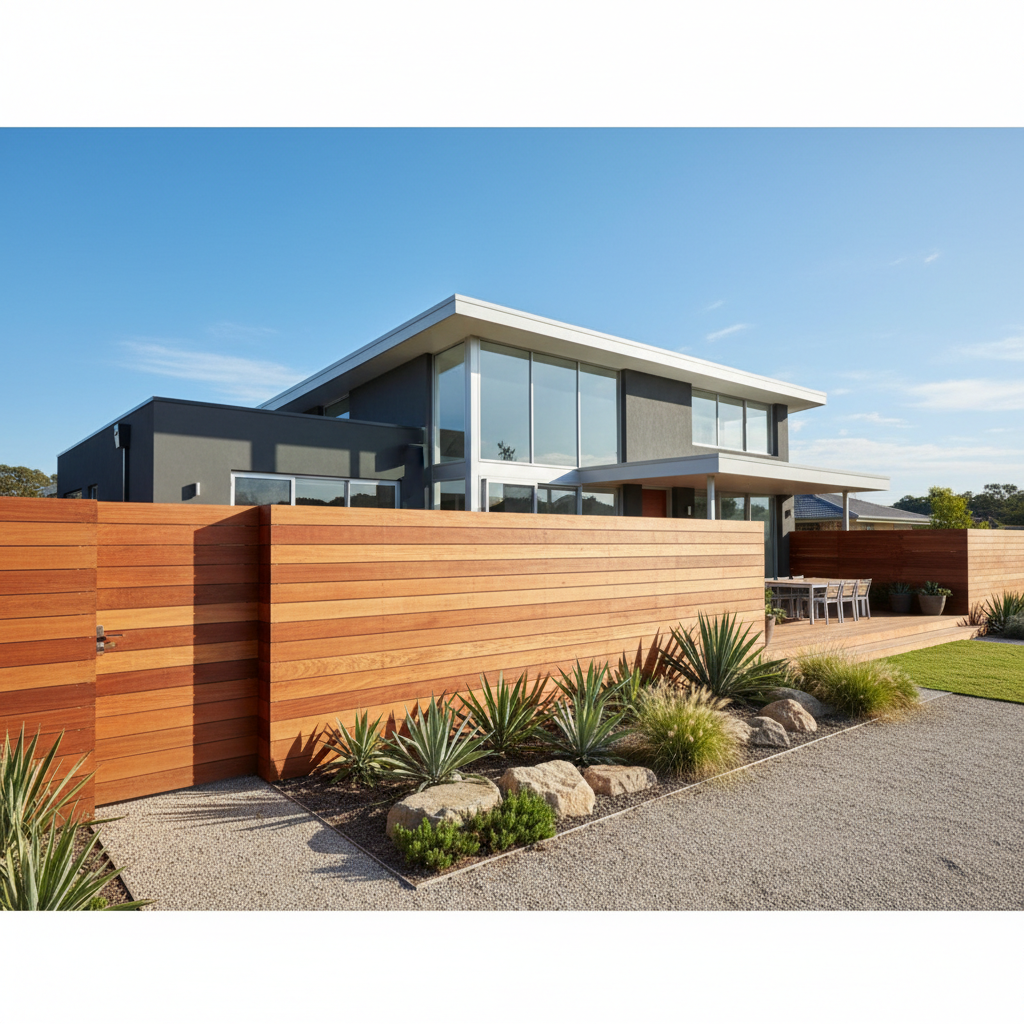
Why Choose Cumaru for Fencing
Cumaru fencing — commonly known as Brazilian Teak fencing — is the smart choice for homeowners who want a genuine hardwood fence without stretching to Ipe pricing. With a Janka hardness of 3,330 lbf, a Cumaru fence is nearly as hard as premium tropical hardwood and dramatically harder than any cedar, redwood, or pressure-treated fence on the market. For large fencing projects where you're enclosing an entire property, the per-linear-foot savings over Ipe add up fast while delivering 90% of the performance.
Brazilian Teak fence boards are naturally resistant to rot, decay, mold, and termites without any chemical treatment. This makes Cumaru fencing safe for backyards where kids play, dogs run, and vegetable gardens grow — no copper, no arsenic, no preservatives touching your soil. The wood carries a Class A fire rating, the same as Ipe and concrete, meeting the most stringent building codes.
Fresh Cumaru fence pickets display warm reddish-brown to golden-tan tones with attractive natural variation between boards. This color range creates a rich, organic-looking fence that stands out against the monotony of uniform vinyl or the roughness of pressure-treated lumber. The warm tones of a Brazilian Teak fence complement virtually every home style. Untreated, Cumaru weathers to a silver-gray patina, or you can maintain the original brown with annual UV oil.
A Cumaru fence lasts up to 50+ years — roughly three times longer than cedar and four to five times longer than pressure-treated pine. When you calculate the cost of replacing a cedar fence twice or a pine fence three times over 50 years, Cumaru fencing is actually the most economical choice for long-term property owners. Cumaru fence boards work beautifully in privacy, horizontal slat, and board-on-board designs.
How does a Cumaru fence compare to cedar? Cumaru is nearly 10 times harder (3,330 vs 350 Janka), lasts 2.5-3 times longer, and never needs the chemical staining and sealing that cedar demands every 2-3 years to prevent rot. For the price of maintaining a cedar fence over its lifetime, you could have installed Cumaru once and been done.
Fence Styles You Can Build with Cumaru
Classic privacy fencing. Vertical boards with optional gaps for airflow.
Best for: Privacy, security
Pickets: 1x4, 1x6, or 5/4x4 | Rails: 2x4 or 2x6
Modern architectural look. Horizontal boards run between posts for a contemporary feel.
Best for: Modern homes, curb appeal
Boards: 1x4, 1x6 | Posts: 4x4 or 6x6
Alternating boards on both sides for full privacy from any angle. Premium appearance.
Best for: Full privacy, neighborhoods
Pickets: 1x6 | Rails: 2x4 or 2x6
Architectural and specialty designs. Custom milling available for unique profiles.
Best for: Accent fences, entries
Contact us for custom profiles
What You Need for a Cumaru Fence
Pickets (face boards)
- • 1x4 — Narrow pickets, decorative spacing
- • 1x6 — Standard privacy picket (most popular)
- • 5/4x4 — Thicker picket for added rigidity
Rails (horizontal supports)
- • 2x4 — Standard rail size
- • 2x6 — Heavy-duty rail for tall fences
- Use 2 rails for fences under 5\'. Use 3 rails for 6\'+ fences.
Posts (vertical structural members)
- • 4x4 — Standard fence post
- Set posts 2-3 feet deep in concrete.
Cumaru Fencing Specifications
| Botanical Name | Dipteryx odorata |
| Common Names | Cumaru, Brazilian Teak, Tonka Bean |
| Janka Hardness | 3,330 lbf |
| Density | 65 lbs/ft³ |
| Durability Class | Class 1 |
| Fire Rating | Class A (ASTM E84) |
| Rot Resistance | Excellent |
| Insect Resistance | Excellent |
| Ground Contact | Excellent |
| Expected Fence Lifespan | Up to 50+ years |
| Color (Fresh) | Reddish-brown to tan with variation |
| Color (Weathered) | Silver-gray patina |
| Chemical Treatment Required | No |
| Available Picket Sizes | 1x4, 1x6, 5/4x4 |
| Available Rail Sizes | 2x4, 2x6 |
| Available Post Sizes | 4x4 |
| Origin | South America (Brazil, Peru, Colombia) |
Fencing Installation Tips for Cumaru
Pre-drill all fastener holes with carbide-tipped bits — Cumaru is extremely dense. Use stainless steel screws exclusively. Set posts 2.5-3 feet deep in concrete. Standard post spacing is 6-8 feet on center. Use 3 rails for fences 6 feet or taller. Seal cut ends immediately. Allow 7-14 days of on-site acclimation. Leave 1/2 inch bottom gap for drainage.
Cumaru Fence vs. The Alternatives
| Feature | Cumaru | Cedar | PT Pine | Vinyl | Composite |
|---|---|---|---|---|---|
| Lifespan | Up to 50+ yrs | 15-20 yrs | 10-15 yrs | 20-30 yrs | 20-25 yrs |
| Rot Resistance | Natural | Moderate | Chemical | N/A | Low |
| Insect Resistance | Natural | Moderate | Chemical | N/A | Low |
| Maintenance | Optional oil | Stain yearly | Stain yearly | Wash only | Wash only |
| Chemical Treatment | None | None | Yes | Plastic | Plastic/wood |
| Strength (Janka) | 3,330 lbf | 350 lbf | 690 lbf | N/A | N/A |
| Fire Rating | Class A | Not rated | Not rated | Melts | Melts |
| Eco-Friendly | Yes — natural | Yes — natural | No — chemicals | No — plastic | No — plastic |
Cumaru Fence vs Ipe Fence
Ipe is slightly harder (3,680 vs 3,330 Janka) and lasts longer (up to 75+ vs 50+ years). Cumaru fencing delivers 90% of Ipe's performance at a lower price — ideal for large fencing projects where budget matters.
Learn more about Ipe FenceCumaru Fence vs Cedar Fence
Cedar fences are nearly 10 times softer than Cumaru (350 vs 3,330 Janka) and last only 15-20 years with constant maintenance. A Cumaru fence lasts up to 50+ years with none of the staining, sealing, or rot treatment cedar requires.
Cumaru Fence vs Pressure-Treated Pine
Pressure-treated pine contains chemicals that leach into soil. Cumaru is 100% natural, lasts 4-5 times longer, and never warps or cups like pine does within its first few years.
Cumaru Fencing FAQ
All Cumaru Fencing Sizes & Profiles
Every available cumaru fencing product — click to view pricing and details.
Explore More Fencing
All Hardwood Fencing
Browse all species
Ipe Fencing
Shop ipe fencing
Tigerwood Fencing
Shop tigerwood fencing
Garapa Fencing
Shop garapa fencing
Massaranduba Fencing
Shop massaranduba fencing
Red Balau Fencing
Shop red balau fencing
About Cumaru Wood
Species information & properties
All Hardwood Species
Compare all species