.png?width=180&quality=75&format=webp)
Why Choose Tigerwood for Fencing
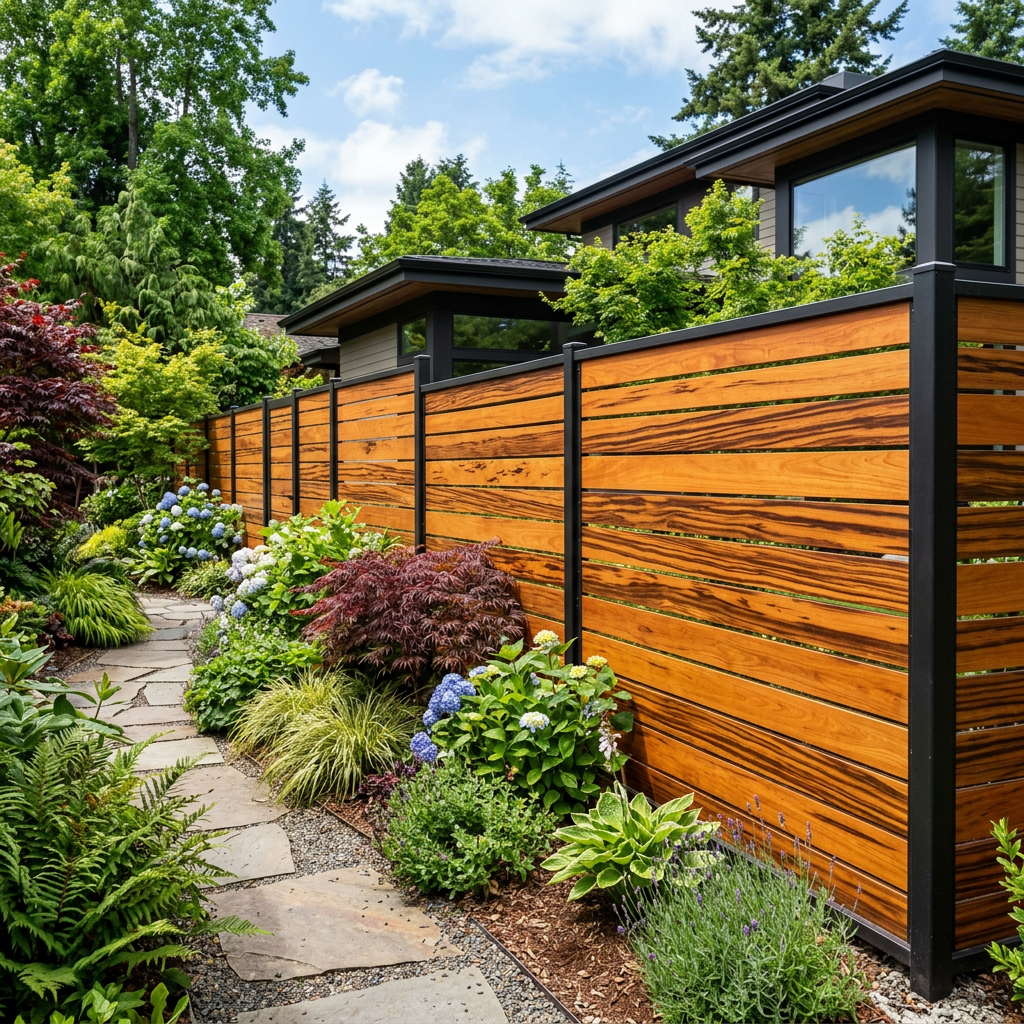
A Tigerwood fence is the ultimate statement piece for your property. No other fencing material — wood, vinyl, composite, or metal — offers the dramatic visual impact of Tigerwood's signature orange-brown base streaked with dark brown to black tiger stripes. When your neighbors are looking at uniform cedar or bland vinyl, a Tigerwood fence stops people on the sidewalk.
Beyond the showstopping aesthetics, Tigerwood fencing delivers genuine hardwood durability. At 2,160 Janka, Tigerwood fence boards are more than six times harder than cedar and substantially harder than any pressure-treated pine. The wood naturally resists rot, decay, and insects for up to 40+ years without any chemical treatment — safe for every yard, every family, every garden.
Tigerwood fence pickets are particularly stunning in horizontal slat designs, where the striped grain runs the full length of each board and creates a flowing visual pattern across the fence face. The dramatic contrast between light and dark tones on each board means no two Tigerwood fences look exactly alike. For front-yard fences, entry walls, and any location where the fence is a design feature rather than just a boundary marker, Tigerwood is unmatched.
The color of a fresh Tigerwood fence is vivid — warm oranges, deep browns, and near-black streaks that catch sunlight beautifully. Over time, the stripes mellow and the overall tone deepens into a rich patina. With UV oil, you preserve the vivid contrast; without it, Tigerwood weathers to silver-gray where the striped pattern remains faintly visible — a subtle texture that architects love.
How does a Tigerwood fence compare to cedar? Tigerwood is six times harder, lasts twice as long (up to 40+ vs 15-20 years), and never needs the constant staining and sealing that cedar demands. The visual comparison isn't even close — Tigerwood's tiger-stripe grain makes cedar's plain appearance look ordinary.
Fence Styles You Can Build with Tigerwood
Classic privacy fencing. Vertical boards with optional gaps for airflow.
Best for: Privacy, security
Pickets: 1x4, 1x6, or 5/4x4 | Rails: 2x4 or 2x6
Modern architectural look. Horizontal boards run between posts for a contemporary feel.
Best for: Modern homes, curb appeal
Boards: 1x4, 1x6 | Posts: 4x4 or 6x6
Alternating boards on both sides for full privacy from any angle. Premium appearance.
Best for: Full privacy, neighborhoods
Pickets: 1x6 | Rails: 2x4 or 2x6
Architectural and specialty designs. Custom milling available for unique profiles.
Best for: Accent fences, entries
Contact us for custom profiles
Popular Tigerwood Fencing Products
What You Need for a Tigerwood Fence
Pickets (face boards)
- • 1x4 — Narrow pickets, decorative spacing
- • 1x6 — Standard privacy picket (most popular)
- • 5/4x4 — Thicker picket for added rigidity
Rails (horizontal supports)
- • 2x4 — Standard rail size
- • 2x6 — Heavy-duty rail for tall fences
- Use 2 rails for fences under 5\'. Use 3 rails for 6\'+ fences.
Posts (vertical structural members)
- • 4x4 — Standard fence post
- Set posts 2-3 feet deep in concrete.
Tigerwood Fencing Specifications
| Botanical Name | Astronium spp. |
| Common Names | Tigerwood, Goncalo Alves, Jobillo |
| Janka Hardness | 2,160 lbf |
| Density | 56 lbs/ft³ |
| Durability Class | Class 1-2 |
| Fire Rating | Class A (ASTM E84) |
| Rot Resistance | Very Good |
| Insect Resistance | Very Good |
| Ground Contact | Good |
| Expected Fence Lifespan | Up to 40+ years |
| Color (Fresh) | Orange-brown with dark streaks (tiger stripes) |
| Color (Weathered) | Silver-gray patina |
| Chemical Treatment Required | No |
| Available Picket Sizes | 1x4, 1x6, 5/4x4 |
| Available Rail Sizes | 2x4, 2x6 |
| Available Post Sizes | 4x4 |
| Origin | Central & South America (Brazil, Mexico) |
Fencing Installation Tips for Tigerwood
Pre-drill all fastener holes — Tigerwood is dense hardwood. Use stainless steel screws. Set posts 2.5-3 feet deep in concrete with 6-8 foot spacing. Use 3 rails for 6-foot fences. Seal cut ends immediately. Allow 7-14 days acclimation. For horizontal slat designs, the stripe pattern runs lengthwise for maximum visual effect.
Tigerwood Fence vs. The Alternatives
| Feature | Tigerwood | Cedar | PT Pine | Vinyl | Composite |
|---|---|---|---|---|---|
| Lifespan | Up to 40+ yrs | 15-20 yrs | 10-15 yrs | 20-30 yrs | 20-25 yrs |
| Rot Resistance | Natural | Moderate | Chemical | N/A | Low |
| Insect Resistance | Natural | Moderate | Chemical | N/A | Low |
| Maintenance | Optional oil | Stain yearly | Stain yearly | Wash only | Wash only |
| Chemical Treatment | None | None | Yes | Plastic | Plastic/wood |
| Strength (Janka) | 2,160 lbf | 350 lbf | 690 lbf | N/A | N/A |
| Fire Rating | Class A | Not rated | Not rated | Melts | Melts |
| Eco-Friendly | Yes — natural | Yes — natural | No — chemicals | No — plastic | No — plastic |
Tigerwood Fence vs Cedar Fence
Cedar fences are six times softer than Tigerwood (350 vs 2,160 Janka) and last only 15-20 years. Tigerwood lasts up to 40+ years with no maintenance required, plus its dramatic striped grain is incomparably more beautiful.
Tigerwood Fence vs Ipe Fence
Ipe is nearly twice as hard as Tigerwood (3,680 vs 2,160 Janka) and lasts longer, but lacks Tigerwood's dramatic visual impact. Choose Ipe for maximum durability or Tigerwood when your fence needs to make a visual statement.
Learn more about Ipe FenceTigerwood Fence vs Cumaru Fence
Cumaru is harder (3,330 vs 2,160 Janka) with warm uniform tones. Tigerwood wins on aesthetics with its signature striped grain — the choice depends on whether you prioritize maximum durability or maximum visual impact.
Learn more about Cumaru FenceTigerwood Fencing FAQ
All Tigerwood Fencing Sizes & Profiles
Every available tigerwood fencing product — click to view pricing and details.
Explore More Fencing
All Hardwood Fencing
Browse all species
Ipe Fencing
Shop ipe fencing
Cumaru Fencing
Shop cumaru fencing
Garapa Fencing
Shop garapa fencing
Massaranduba Fencing
Shop massaranduba fencing
Red Balau Fencing
Shop red balau fencing
About Tigerwood Wood
Species information & properties
All Hardwood Species
Compare all species