.png?width=180&quality=75&format=webp)
Know When Your Tropical Hardwood Is Actually Ready to Install
Estimate real-world acclimation time based on your location, season, board thickness, and storage conditions—before you fasten a single board.
Most decking failures we see start with installing too early. This tool helps prevent that.
What this calculator does:
- Estimates acclimation time using regional climate averages
- Accounts for dense tropical hardwood behavior (Ipe, Cumaru, Garapa, etc.)
- Helps avoid cupping, checking, and excessive movement after installation
⬇ Start by entering your project location and installation month
Don't know your moisture content? Learn how to measure itEstimate Mode
Quick Estimate uses typical starting moisture and standard outdoor storage. You can fine-tune anytime.
We use this to calculate local climate conditions.
Default: Covered + stickered + elevated
Default: Partial sun
Your Acclimation Estimate
Your acclimation estimate will appear here
Once you enter a few details, we'll calculate:
- Estimated acclimation duration
- Expected moisture movement range
- Readiness guidance before installation
Based on climate data and typical tropical hardwood behavior.
How to Test Moisture Content Using a Moisture Meter
Proper testing ensures your hardwood is ready for installation
Pin-Type Meters
Most Accurate for Tropical Hardwoods ✓
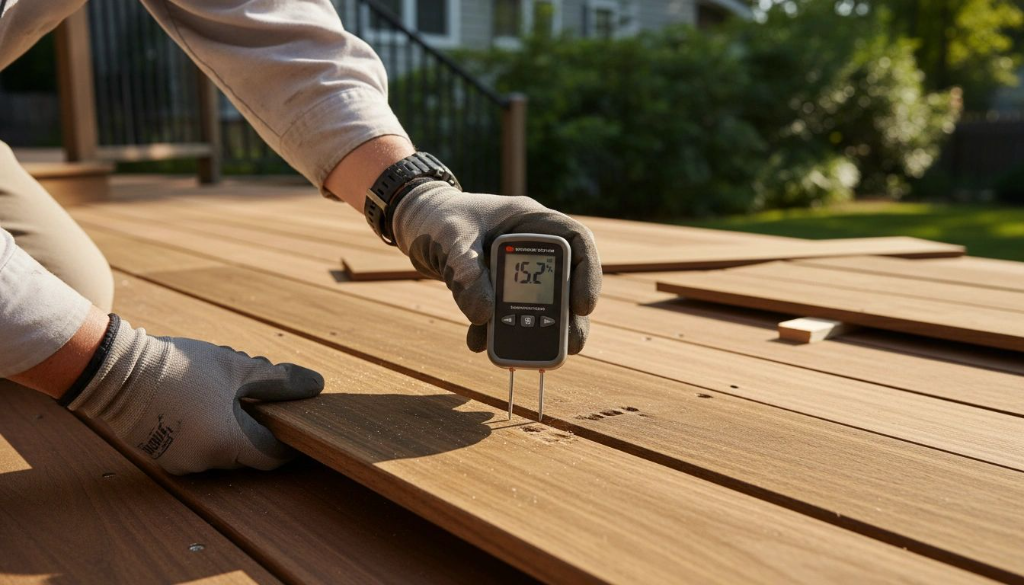
Pin meters drive two metal probes into the wood and measure electrical resistance. Because tropical hardwoods are so dense and oily, pin meters provide better accuracy—especially for internal moisture readings.
Best for:
- Tropical hardwood decking
- Thick material (5/4, 2x, 4x)
- Getting internal moisture readings
Pinless Meters
Convenient but Less Reliable for Tropical Species
Pinless meters use electromagnetic sensors to read moisture without puncturing the surface. Fast and non-invasive, but less accurate on ultra-dense hardwoods—especially those with natural oils.
Best for:
- Quick screening
- Softwoods and domestic hardwoods
- Surface-level checks
Step-by-Step: How to Measure Correctly
Use a Quality Meter with Species Adjustment
Tropical hardwoods are much denser than pine or oak. If your meter allows species settings, you must adjust it properly.
Important: If your meter doesn't have a tropical hardwood setting, use the manufacturer's correction chart or select the closest dense hardwood option.
Measure More Than One Board
Moisture content can vary between boards, even within the same shipment. You should test:
- Several boards from different parts of the bundle
- Both long and short boards
- Both outer boards and interior boards
Best Practice: Test 10-15 boards per delivery, especially on larger orders.
Test the Right Locations on Each Board
Wood dries unevenly—especially dense hardwoods. For best results:
- Measure at least 3 points per board: One near each end (but not right at the end grain), and one near the center
- If using a pin meter, push pins into the wood at least 1/4 inch or deeper depending on thickness
- Avoid testing directly on knots, cracks, and end grain for standard readings
Compare Multiple Readings (Consistency Matters)
The best indicator of readiness isn't one "perfect number"—it's consistency.
Example of Uneven Moisture:
If a board reads 12% at one end and 18% at the other end, that board has uneven moisture distribution and may still move significantly after installation.
✓ Look for tight moisture ranges across the board and between boards.
Exterior Decking & Outdoor
Normal for outdoor installations. Exterior wood will eventually equilibrate with outdoor humidity and rainfall conditions.
Interior Installations
For interior flooring, trim, or furniture. Must acclimate longer and be verified carefully.
Common Mistakes When Measuring Moisture Content
Only Testing One Board
Moisture variation across a bundle is common. Always test multiple boards from different locations.
No Species Adjustment
This can throw readings off significantly with tropical hardwood. Always use proper species settings.
Testing Only the Surface
Dense hardwood often dries from the outside inward. Use pin meters to check internal moisture.
Testing End Grain Only
End grain absorbs and releases moisture much faster and can give misleading results.
Important Disclaimer
This calculator provides an estimate based on typical climate averages. Actual acclimation varies based on airflow, sun exposure, stacking method, rain exposure, and microclimate conditions. Always verify readiness using a moisture meter and stable readings before installation. Ipe Woods USA is not responsible for installation outcomes. This tool is for planning purposes only.