.png?width=180&quality=75&format=webp)
Learn more about ipe wood — species properties, sustainability, and care guide. Read about ipe deck cost per square foot, or compare hidden fasteners for ipe.
Why Choose Ipe Decking
Ipe decking is the benchmark against which all other decking materials are measured. With a Janka hardness rating of 3,680 lbf, Ipe is more than eight times harder than pressure-treated pine and significantly denser than any composite decking product on the market. This extraordinary density translates directly to scratch resistance, structural strength, and an outdoor lifespan of up to 75 years or more with minimal maintenance.
What sets Ipe apart for decking specifically is the combination of performance characteristics that no single alternative can match. The wood's natural oils make it inherently resistant to rot, decay, mold, and insect damage — without any chemical treatment. Ipe carries a Class A fire rating (the same as concrete and steel), making it one of the safest decking choices for wildfire-prone regions and commercial applications where fire codes are stringent.
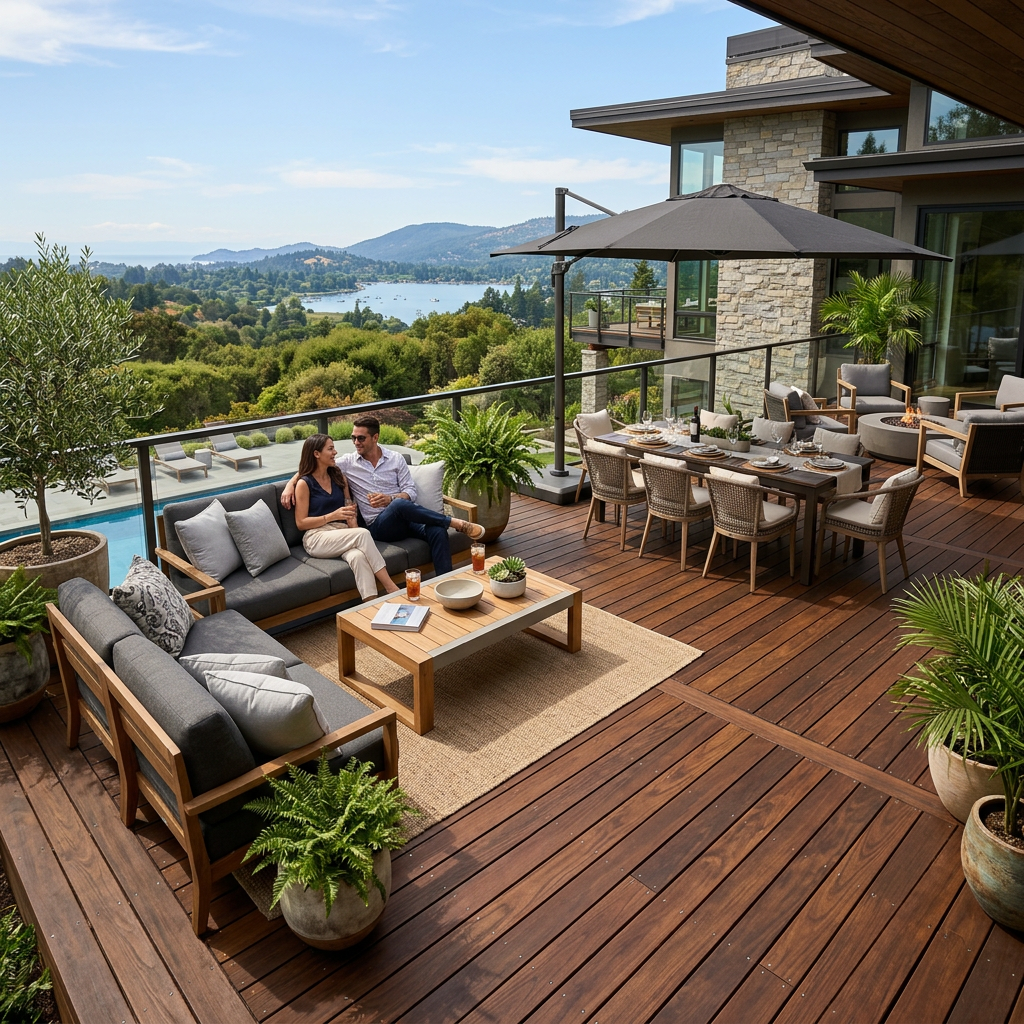
Fresh Ipe decking boards display a rich olive-brown to dark chocolate-brown color with subtle grain variation that gives each board character. Left untreated, the wood weathers to an elegant silver-gray patina over 6-12 months — a look many homeowners prefer for its low-maintenance appeal. For those who want to preserve the original brown tones, annual application of a UV-protective oil maintains the color beautifully.
Ipe decking is the preferred choice for residential decks, commercial boardwalks, pool surrounds, rooftop terraces, and marine applications including docks and piers. The Coney Island boardwalk, numerous coastal promenades, and thousands of high-end residential projects across the U.S. showcase Ipe's proven performance in demanding environments.
Compared to composite decking, Ipe offers a natural aesthetic that synthetics cannot replicate, significantly longer lifespan, and better heat performance underfoot in direct sun. While the initial cost is higher than pressure-treated lumber or composite alternatives, the total cost of ownership over decades is substantially lower due to Ipe's extraordinary longevity (up to 75+ years) and near-zero maintenance requirements. Ipe is responsibly sourced through selective harvesting practices that preserve rainforest ecosystems.
Ipe Decking Size Comparison: 1x4 vs 1x6 vs 5/4x6
Choosing the right board size is one of the most important decisions for your deck project. Here's how the three most popular sizes compare:
| Size | Actual Dimensions | Weight per LF | Best Use Case | Max Joist Spacing |
|---|---|---|---|---|
| 1x4 | 3/4" × 3.5" | ~1.3 lbs | Modern narrow-plank look, railings, trim | 16" OC |
| 1x6 | 3/4" × 5.5" | ~2.0 lbs | Most popular residential decking size | 16" OC |
| 5/4x6 ★ | 1" × 5.5" | ~2.6 lbs | Industry standard — best strength/value balance | 24" OC |
★ 5/4x6 is our #1 recommendation for residential Ipe decks — the extra thickness provides superior rigidity, allows wider joist spacing, and delivers the best long-term value. See all available Ipe wood sizes.
Pregrooved vs Eased Edge Ipe Decking
Every Ipe decking board is available in two main profiles. The profile determines how the boards attach to your joists.
Pregrooved (Hidden Fasteners)
- No visible screws on the deck surface
- Clips create consistent board spacing
- Premium appearance — most popular choice
- Slightly higher cost (clip system required)
Eased Edge / E4E (Face Screw)
- Traditional face-screw installation
- Fastest and most economical method
- Versatile — also used for fencing, siding
- Screws are visible but provide maximum hold
Not sure which to choose? Read our hidden fastener comparison or use the deck builder tool for guided help.
Ipe Decking Cost
Ipe decking material ranges from approximately $5–$12 per linear foot depending on board size, profile, and grade. The most popular 5/4x6 E4E boards start around $9–$10/LF, while 1x6 boards start around $7–$8/LF. Pregrooved and tongue & groove profiles include a milling upcharge over the base eased-edge price.
For a typical 300 SF residential deck, expect to spend $2,500–$5,000 on Ipe decking material alone — plus fasteners, substructure, and labor. While Ipe's upfront cost exceeds composite or pressure-treated alternatives, its up to 75+ year lifespan makes it the most cost-effective choice over time. A composite deck may need 2–3 complete replacements over the same period.
For detailed installed cost breakdowns with labor rates by region, see our ipe decking cost per square foot guide. Compare all species on our live pricing page.
Understanding Ipe Decking Grades
Ipe decking lumber is graded based on visual appearance, grain consistency, and the presence of natural characteristics like knots, mineral streaks, and color variation. All grades of Ipe share the same structural properties — the 3,680 lbf Janka hardness, Class A fire rating, and Class 1 durability classification apply regardless of grade. The difference is purely cosmetic.
FAS (First and Seconds) — Premium Grade
FAS is the highest available grade of Ipe decking. Boards are selected for consistent color, tight grain, minimal knots, and few natural markings. FAS Ipe is the preferred choice for high-visibility residential decks, commercial entryways, and architectural projects where uniform appearance matters. Expect the fewest defects and the most consistent board-to-board color matching.
Select & Better — Standard Grade
Select & Better is the most commonly ordered grade for residential Ipe decking projects. These boards may have small tight knots, minor color variation, and occasional mineral streaks — all natural characteristics that add character without affecting performance. Select & Better Ipe delivers excellent appearance at a more accessible price point than FAS, and many homeowners prefer the natural variation.
#1 Common — Value Grade
#1 Common grade Ipe includes boards with more visible natural characteristics: larger knots (sound and tight), wider color variation, and more pronounced grain patterns. Every board is structurally sound and carries the same durability ratings. This grade works well for projects where rustic character is desired, on lower-visibility areas like ground-level decks, or when budget is a primary consideration.
Grade availability varies by board size and current inventory. Not all sizes are available in all grades at all times. Contact us or check the product page for current grade availability and pricing.
Ipe Sustainability & Responsible Harvesting
All Ipe lumber sold by Ipe Woods USA is legally harvested and imported in full compliance with the U.S. Lacey Act, which prohibits trade in illegally sourced wood products. Our supply chain uses selective harvesting — only mature trees are taken, preserving the surrounding forest canopy and ecosystem. This approach ensures long-term forest health and sustained Ipe availability.
Ipe trees grow naturally across Central and South America, primarily in Brazil, Bolivia, and Peru. Because Ipe represents a small fraction of trees per acre in its native habitat, selective harvesting has minimal ecological impact compared to plantation-grown or clear-cut timber operations. Full chain-of-custody documentation is available upon request for projects that require it.
The extraordinary lifespan of Ipe decking — up to 75+ years — also contributes to its sustainability profile. A single Ipe deck outlasts two to three composite decks or four to five pressure-treated decks, dramatically reducing the total material consumption, manufacturing energy, and landfill waste over the life of a home.
Quick Ipe Decking Links
Ipe Decking Specifications
| Botanical Name | Handroanthus spp. (formerly Tabebuia) |
| Common Names | Ipe, Brazilian Walnut, Lapacho, Ironwood, Pau Lope |
| Janka Hardness | 3,680 lbf |
| Density | 69 lbs/ft³ |
| Durability Class | Class 1 |
| Fire Rating | Class A (ASTM E84) |
| Rot Resistance | Excellent |
| Insect Resistance | Excellent |
| Expected Lifespan | Up to 75+ years |
| Color (Fresh) | Olive-brown to dark chocolate-brown |
| Color (Weathered) | Silver-gray patina |
| Available Thicknesses | 1x, 5/4, 2x |
| Available Widths | 4", 6" |
| Profiles | Pregrooved, Eased Edge (E4E), T&G |
| Origin | Central & South America (Brazil, Bolivia, Peru) |
Installation & Maintenance Guide
Ipe Installation Tips
Ipe's extreme density (3,680 Janka) means all screw holes must be pre-drilled with carbide-tipped drill bits. Standard drill bits dull quickly in Ipe. Use stainless steel fasteners exclusively — galvanized or zinc-coated screws will corrode and cause black staining. For hidden fastener systems, choose pregrooved boards with compatible clip systems like Ipe Clip or DeckWise.
- Pre-drilling required for all screw holes
- 16" on-center joist spacing for standard residential installations
- Stainless steel fasteners required — no galvanized or zinc-coated
- Acclimate boards on-site before installation
Maintenance Options
Oil for color: Apply UV-protective oil annually to maintain the natural olive-brown to dark chocolate-brown tones. See our ipe deck maintenance guide for product recommendations.
Let it gray: No treatment needed — Ipe will weather to a beautiful silver-gray patina with zero impact on durability.
How Ipe Compares
Ipe vs Cumaru
Cumaru (Brazilian Teak) is the closest alternative to Ipe, offering 90% of the performance at a lower price point. Cumaru's 3,330 Janka hardness and warm reddish-brown tones make it the best-value premium hardwood decking option.
Learn more about Cumaru deckingIpe vs Composite
Composite decking costs less upfront but lasts 25-30 years compared to Ipe's up to 75+. Composites can fade, scratch, and retain heat more than natural Ipe, making Ipe the better long-term investment.
Learn more about Composite deckingIpe vs Tigerwood
Tigerwood offers the most visually dramatic decking with its signature striped grain pattern. While not as hard as Ipe (2,160 vs 3,680 Janka), Tigerwood provides excellent durability with unmatched aesthetics.
Learn more about Tigerwood deckingIpe Decking FAQ
All Ipe Decking Sizes & Profiles
Every available ipe decking product — click to view pricing and details.
Explore More Decking
All Hardwood Decking
Browse all species
Cumaru Decking
Shop cumaru decking
Tigerwood Decking
Shop tigerwood decking
Garapa Decking
Shop garapa decking
Massaranduba Decking
Shop massaranduba decking
Red Balau Decking
Shop red balau decking
About Ipe Wood
Species information & properties
All Hardwood Species
Compare all species