.png?width=180&quality=75&format=webp)
Why Choose Jatoba for Siding & Cladding
Jatoba siding — Brazilian Cherry — delivers a warm, red-toned hardwood facade with genuine tropical hardwood performance behind it. At 2,350 lbf on the Janka scale, Jatoba cladding is roughly seven times harder than western red cedar and nearly twice as hard as white oak, giving exterior walls real resistance to hail, impact, and wind-driven debris.
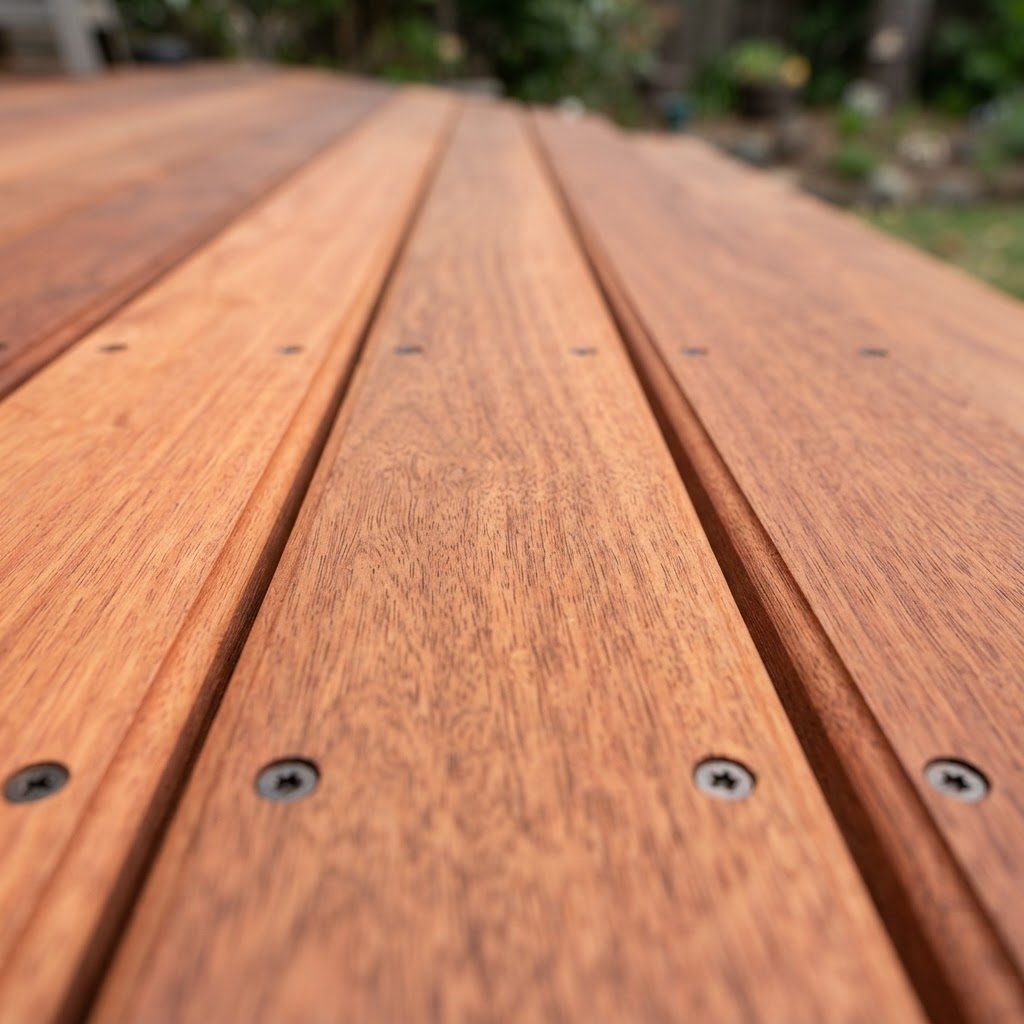
The appeal of Jatoba on a facade is its color story. Fresh boards come off the mill in salmon-red and orange-brown tones, then deepen over the first several months of light exposure into a saturated reddish-brown that no stain can convincingly imitate. That natural darkening is why Jatoba became the dominant Brazilian Cherry flooring species — and it works the same way on a wall. Left alone, Jatoba siding eventually weathers to silver-gray like every tropical hardwood; annual UV oil holds the red instead.
Jatoba is naturally resistant to rot, decay, and insect attack without chemical treatment, and it carries a Class A fire rating (ASTM E84) for WUI and commercial code compliance. Expect up to 40+ years of exterior service with reasonable detailing and maintenance.
Because Jatoba is more responsive to moisture change than Ipe, detailing matters more: install over a proper rainscreen or drainage plane, keep boards off grade, and let the wall assembly dry in both directions. Done correctly, Jatoba shiplap and rainscreen cladding is a striking, long-lived facade at a price well below Ipe.
Against fiber cement, Jatoba never needs paint and brings real grain and depth to the wall. Against cedar, it is dramatically harder, lasts two to three times longer, and requires no rot treatment.
Siding Profiles Available in Jatoba
Overlapping boards with a distinctive shadow line. Classic exterior look for traditional and modern facades.
Best for: Traditional facade, accent walls
Interlocking boards for a seamless, flush surface. Excellent weather protection with a refined appearance.
Best for: Soffits, porch ceilings, protected walls
Jatoba Siding Specifications
| Botanical Name | Hymenaea courbaril |
| Common Names | Jatoba, Brazilian Cherry, Courbaril |
| Janka Hardness | 2,350 lbf |
| Density | 57 lbs/ft³ |
| Durability Class | Class 1-2 |
| Fire Rating | Class A (ASTM E84) |
| Rot Resistance | Very Good |
| Insect Resistance | Very Good |
| Expected Lifespan (exterior) | Up to 40+ years |
| Color (Fresh) | Salmon-red to orange-brown, deepening to reddish-brown |
| Color (Weathered) | Silver-gray patina |
| Available Thicknesses | 1x, 5/4 |
| Available Widths | 4", 6", 8" |
| Available Profiles | Shiplap, Tongue & Groove, Rainscreen, E4E |
| Origin | Central & South America (Brazil, Peru, Bolivia) |
Available Jatoba Siding Sizes
Installation Essentials for Jatoba Siding
Install Jatoba siding over a rainscreen or drainage plane — non-negotiable for a species this responsive to moisture. Pre-drill all fastener holes and use stainless steel fasteners only (316 grade at the coast); Jatoba's extractives will stain around galvanized screws. Acclimate boards on-site for 10-14 days, seal all cut ends immediately, and hold consistent expansion gaps at ends and transitions. Both horizontal and vertical orientations work; keep bottom courses well above grade and away from splashback.
- Rainscreen/drainage plane — required behind all exterior siding
- Stainless steel fasteners — 316 grade for coastal environments
- Acclimate 7-14 days on-site before installation
- Seal cut ends immediately with end-grain sealer
How Jatoba Siding Compares
Jatoba Siding vs Ipe Siding
Ipe is considerably harder (3,680 vs 2,350 Janka) and lasts longer (up to 75+ vs 40+ years) but reads much darker. Jatoba gives you a brighter red facade at a lower cost.
Learn more about Ipe SidingJatoba Siding vs Cedar Siding
Cedar is about seven times softer than Jatoba (350 vs 2,350 Janka) and needs regular staining to hold off rot. Jatoba lasts two to three times longer with no chemical treatment.
Jatoba Siding vs Massaranduba Siding
Both are red hardwood claddings. Massaranduba is denser and longer-lived with a deeper brick-red tone; Jatoba is brighter, more orange-red, and easier to cut and fasten.
Learn more about Massaranduba SidingJatoba Siding FAQ
All Jatoba Siding Sizes & Profiles
Every available jatoba siding product — click to view pricing and details.
Explore More Siding
All Hardwood Siding
Browse all species
Ipe Siding
Shop ipe siding
Cumaru Siding
Shop cumaru siding
Tigerwood Siding
Shop tigerwood siding
Garapa Siding
Shop garapa siding
Massaranduba Siding
Shop massaranduba siding
Red Balau Siding
Shop red balau siding
About Jatoba Wood
Species information & properties
All Hardwood Species
Compare all species