.png?width=180&quality=75&format=webp)
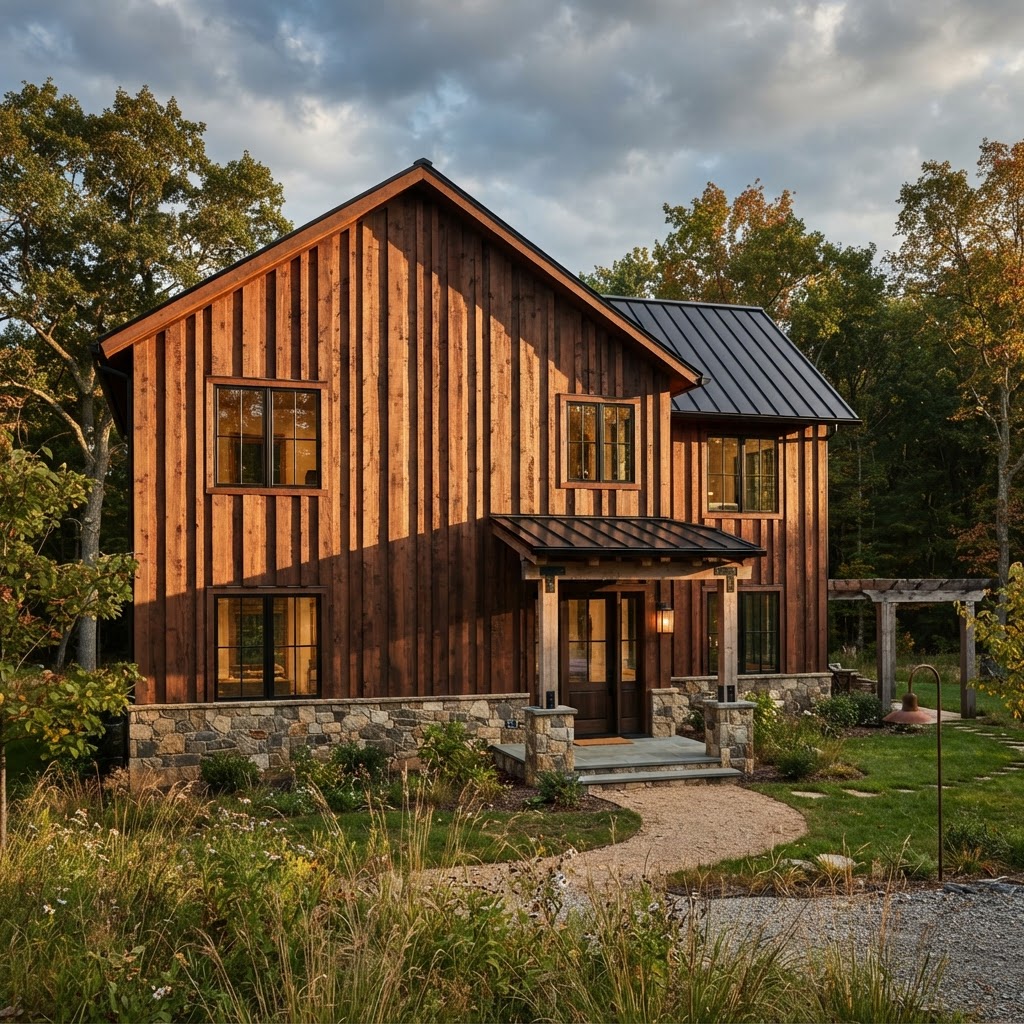
Channel Siding — Rustic Hardwood Channel Profiles
Channel (channel rustic) siding overlaps board-over-board with a wide, deep reveal channel between courses. Bold shadow lines, excellent water management, and a rustic character that suits barns, farmhouse-modern, and commercial rustic designs.
Available in Ipe, Cumaru, Garapa, Tigerwood, Massaranduba, and Red Balau. Part of our hardwood siding line — custom profiles available.
What Is Channel Siding?
Channel siding — often called channel rustic — is an overlapping profile in which each board’s rabbeted edge laps the adjacent board while leaving a wide, recessed channel (typically 1/2" to 3/4") exposed between courses. The channel is deeper and wider than a nickel gap reveal, producing a bold, rustic shadow line, and the generous overlap lets boards move seasonally without ever opening a gap to the weather. That combination of forgiving movement and strong water shedding has made channel siding a barn and ranch staple for a century; milled in Ipe, Cumaru, or Garapa it becomes a rustic profile that will outlast the structure it clads.
Channel Profile Design
Profile & Reveal
- ✓ Rabbeted overlap with a wide recessed channel (~1/2"–3/4") between boards
- ✓ Deepest, boldest shadow line of any lap profile
- ✓ Generous overlap accommodates seasonal movement without exposing gaps
- ✓ Sheds water effectively in both horizontal and vertical orientation
Fastening
- • Face-screw with stainless steel fasteners on wider boards
- • Blind fastening possible on narrower widths — specify per SKU
- • One fastener per stud line — never double-pin across the width
- • Pre-drill all holes; seal cut ends immediately
See our hidden fastener guide and fastening comparison.
Best Applications
- • Rustic exteriors, barns, and outbuildings
- • Farmhouse-modern residential design
- • Commercial rustic (restaurants, breweries, lodges)
- • Vertical board installations
- • High-movement climates — the overlap never opens a gap
Horizontal vs Vertical
Channel siding installs horizontally or vertically. Vertical channel over horizontal furring is a signature barn/modern-farmhouse look and drains extremely well.
Interior vs Exterior Use
For exterior applications, Building Science Corporation recommends weather barriers and drainage planes behind wood cladding systems.
Interior Installations:
- • Focus on visual consistency and finish quality
- • Minimal maintenance requirements
Exterior Installations:
- • Require appropriate weather barriers and drainage
- • Use stainless steel fasteners (316 in coastal areas)
- • May be oiled or left to silver naturally
Shop Channel by Size & Species
Every combination below opens a live-pricing configurator — pick grade and lengths, see per-foot pricing, and add to cart.
| Size | Ipe | Cumaru | Garapa | Tigerwood | Massaranduba | Red Balau |
|---|---|---|---|---|---|---|
| 1x4 | Shop → | Shop → | Shop → | Shop → | Shop → | Shop → |
| 1x6 | Shop → | Shop → | Shop → | Shop → | Shop → | Shop → |
| 5/4x4 | Shop → | Shop → | Shop → | Shop → | Shop → | Shop → |
| 5/4x6 | Shop → | Shop → | Shop → | Shop → | Shop → | Shop → |
| 1x8 | Shop → | — | — | — | — | — |
| 5/4x8 | Shop → | — | — | — | — | — |
Don't see your size? Custom widths and thicknesses are available through our custom milling services.
Compare Species for Channel Siding
| Species | Janka | Lifespan | Color | Best For | |
|---|---|---|---|---|---|
| Ipe | 3,680 lbf | 75+ yrs | Deep chocolate brown | Maximum durability, wildfire zones (Class A) | Shop → |
| Cumaru | 3,540 lbf | 50+ yrs | Golden to reddish brown | Best value in a premium hardwood | Shop → |
| Garapa | 1,700 lbf | 30+ yrs | Golden yellow | Bright, budget-friendly cladding | Shop → |
| Tigerwood | 2,160 lbf | 30+ yrs | Striped orange/brown | Dramatic accent walls & facades | Shop → |
| Massaranduba | 3,190 lbf | 50+ yrs | Deep red | Dense, uniform red tones | Shop → |
| Red Balau | 1,600 lbf | 30+ yrs | Reddish brown | Consistent color at a lower price | Shop → |
Waste Factor & Planning
Order 10–15% extra material for cuts and waste. Vertical installations, complex layouts, and elevations with many openings need the higher end of that range. Our siding calculator can help confirm quantities from your square footage.
Frequently Asked Questions
What is channel siding (channel rustic)?
Channel siding is an overlapping profile with a wide, recessed channel — typically 1/2" to 3/4" — left exposed between boards. The overlap sheds water while the deep channel creates a bold, rustic shadow line.
How does channel siding manage water compared to shiplap?
Channel’s deeper overlap gives more protection against wind-driven rain than flat shiplap, and its recessed channel drains and ventilates each joint. It remains weather-tight even as boards move seasonally.
Can channel be installed vertically?
Yes — vertical channel over horizontal furring strips is a classic barn and modern-farmhouse application, and drains especially well in that orientation.
What overlap and fastener does hardwood channel need?
The milled rabbet sets the overlap automatically. Use stainless steel screws (316 in coastal areas), face-fastened one per stud line on wider boards, pre-drilling every hole.
Is channel siding available in Ipe, Cumaru, and Garapa?
Yes — channel is milled in all six of our tropical species including Ipe, Cumaru, and Garapa, in 1x4, 1x6, 5/4x4, and 5/4x6 (plus 1x8 and 5/4x8 in Ipe).
What is the fire rating and lifespan of hardwood channel siding?
Ipe channel siding is Class A fire rated (ASTM E84) with a 75+ year expected lifespan. Cumaru and Massaranduba offer 50+ years; Garapa, Tigerwood, and Red Balau 30+ years.
Do I need to order extra material?
A waste factor of 10–15% is typically recommended, depending on layout and cut complexity. Vertical installations and complex layouts generally require higher waste factors.
Do I need a weather barrier behind hardwood siding?
Yes. Exterior installations require an appropriate weather-resistive barrier and drainage plane behind the cladding, per building science best practices for wood siding systems.
What grade of fastener should I use?
Stainless steel (304, or 316 in coastal areas) is required for tropical hardwoods. Standard coated fasteners will react with the wood’s natural tannins and stain the boards.
How long should boards acclimate before installation?
Allow boards to acclimate on-site for 7–14 days, stacked with spacers in a covered, ventilated area similar to the installation environment.
Do I need to seal cut ends?
Yes. Seal all field cuts immediately with an end-grain wax sealer to prevent checking and splitting as the board dries.