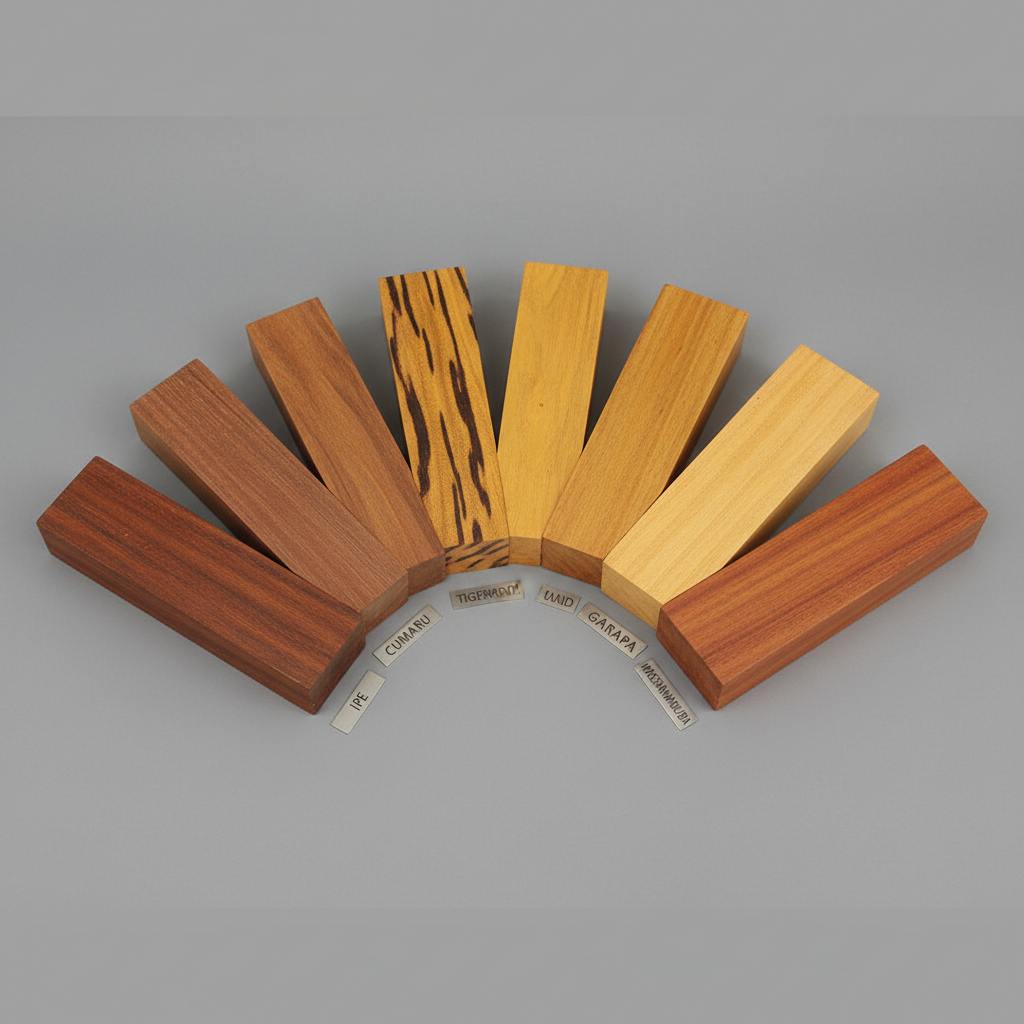
Decking Comparison

Ipe vs Cumaru

The two heavyweights of tropical hardwood — but only one is the champion.

If you're comparing Ipe and Cumaru, congratulations — you've already narrowed your search to two of the best decking materials on the planet. Cumaru (Brazilian Teak) is a genuinely good wood with impressive density and hardness. But 'good' isn't 'best.' Ipe outperforms Cumaru in durability, dimensional stability, lifespan, fire resistance, and long-term maintenance — and the price difference between them is often smaller than people expect.

Strength and durability data referenced from the USDA Forest Products Laboratory Wood Handbook and the Wood Database.

Head-to-Head Comparison

CategoryIpe (Brazilian Walnut)Cumaru (Brazilian Teak / Dipteryx odorata)
Janka Hardness3,680 lbf3,540 lbf
Density69 lbs/cu ft66 lbs/cu ft
Bending Strength (MOR)25,400 psi24,800 psi
Modulus of Elasticity3,140,000 psi3,050,000 psi
Durability ClassClass 1 — HighestClass 1
Dimensional Stability#1 ranked — lowest differential shrinkage (1.4%)Higher differential shrinkage (3.0%) — more prone to cupping
Lifespan (Outdoor)Up to 75+ years25–40+ years
Fire RatingClass A (ASTM E84)Class A (ASTM E84)*
MaintenanceOptional UV oil; minimalRequires more attentive acclimation and maintenance
CostSlightly higher per LF30–40% less than Ipe typically
Climate SuitabilityAll climates — extreme cold to tropicalAll climates — but cupping risk near water
WINNER: IPE

Strengths & Weaknesses

Why Ipe Wins

  • Superior dimensional stability — #1 ranked among all ironwoods (1.4% differential shrinkage)
  • Up to 75+ year outdoor lifespan vs Cumaru's 25–40+ years
  • Higher density (69 vs 66 lbs/cu ft) — more rot and marine borer resistance
  • Significantly less prone to cupping than Cumaru
  • Lower lifetime cost when factoring in longevity — build once, enjoy forever
  • Better performance in wet/marine environments due to superior stability

Where Cumaru Falls Short

  • Known to be prone to cupping — not recommended near water without careful acclimation
  • Higher differential shrinkage (3.0% vs Ipe's 1.4%) — less dimensionally stable
  • Shorter outdoor lifespan — roughly half of Ipe's
  • Not recommended to pre-groove in 3/4" material due to stability concerns
  • Requires more careful acclimation and installation to avoid movement issues
  • Two-tone color variation can be inconsistent

Fair Credit to Cumaru:

  • 30–40% less expensive than Ipe upfront
  • Close Janka hardness (3,540 vs Ipe's 3,680 lbf)
  • Rich two-tone color that many find attractive
  • Still a genuine Class 1 durable tropical hardwood

The Real Value of Choosing Ipe

Increases Home Value

An Ipe deck is a premium feature that elevates your property's appeal and resale value to discerning buyers.

Attracts High-End Buyers

Luxury homebuyers recognize Ipe. It signals quality craftsmanship and long-term investment — making your home stand out.

Build Once, Enjoy Forever

With a lifespan of up to 75+ years, Ipe eliminates the cycle of tearing out and rebuilding every 10–20 years.

Less Construction Hassle

One installation. No repeated contractor visits, no permits for replacements, no weeks of your yard being a construction zone.

The Bottom Line: Ipe vs Cumaru

Cumaru is a good wood — there's no denying that. But if you're already spending the money for Cumaru, the jump to Ipe is often smaller than expected. And what you get for that difference is dramatic: up to 75+ years vs 25–40+, the best dimensional stability of any ironwood, significantly less cupping risk, and higher density. On a cost-per-year-of-ownership basis, Ipe is actually less expensive. If you can afford the best, Ipe is the clear choice.

People who can afford the best choose Ipe — because replacing a deck is expensive, disruptive, and entirely avoidable.

Ipe vs Cumaru — Frequently Asked Questions

Everything you need to know before choosing between Ipe and Cumaru.

Yes — Ipe has a Janka hardness of 3,680 lbf compared to Cumaru's 3,540 lbf. Ipe is also denser (69 vs 66 lbs/cu ft) and has significantly better dimensional stability, which matters even more for long-term decking performance.

Yes — Ipe has a Janka hardness of 3,680 lbf compared to Cumaru's 3,540 lbf. Ipe is also denser (69 vs 66 lbs/cu ft) and has significantly better dimensional stability, which matters even more for long-term decking performance.

Yes. Cumaru has a differential shrinkage of 3.0% compared to Ipe's 1.4%. This means Cumaru is more prone to cupping, especially near water or in humid environments. Proper acclimation helps but doesn't fully eliminate the difference.

Yes. Cumaru has a differential shrinkage of 3.0% compared to Ipe's 1.4%. This means Cumaru is more prone to cupping, especially near water or in humid environments. Proper acclimation helps but doesn't fully eliminate the difference.

Yes — Cumaru typically costs 30–40% less per linear foot than Ipe. However, Ipe lasts significantly longer (up to 75+ years vs 25–40+), making Ipe less expensive on a cost-per-year basis over the life of the deck.

Yes — Cumaru typically costs 30–40% less per linear foot than Ipe. However, Ipe lasts significantly longer (up to 75+ years vs 25–40+), making Ipe less expensive on a cost-per-year basis over the life of the deck.

It depends on your priorities. Cumaru is a solid choice on a tighter budget. But if you're already investing in a premium tropical hardwood deck, the incremental cost to upgrade to Ipe buys you dramatically more longevity, stability, and peace of mind. Many homeowners who start looking at Cumaru end up choosing Ipe once they see the full picture.

It depends on your priorities. Cumaru is a solid choice on a tighter budget. But if you're already investing in a premium tropical hardwood deck, the incremental cost to upgrade to Ipe buys you dramatically more longevity, stability, and peace of mind. Many homeowners who start looking at Cumaru end up choosing Ipe once they see the full picture.

Explore More Comparisons

Choose the Gold Standard

When you're ready for the best, there's only one choice.