.png?width=180&quality=75&format=webp)
Best Tropical Hardwood for Every Budget: From Garapa to Ipe
Discover the best tropical hardwoods for any budget. This guide ranks Garapa, Red Balau, Tigerwood, Cumaru, and Ipe by price, durability, and appearance.
Best Tropical Hardwood for Every Budget: From Garapa to Ipe — A buyer's matrix ranking all five species by price, durability, appearance, and application.
When it comes to selecting the right tropical hardwood for your project, understanding the nuances between each species is vital. This guide breaks down five popular species—Garapa, Red Balau, Tigerwood, Cumaru, and Ipe—ranking them by price, durability, appearance, and application. Whether you're a DIY homeowner or a contractor, this comprehensive buyer's matrix will help you self-select the best choice for your budget.
Quick Summary
- Garapa: Economical and good for moderate climates, price range: $3-5/sq. ft.
- Red Balau: Mid-tier price with high durability, price range: $5-8/sq. ft.
- Tigerwood: Unique appearance at a mid-range price, price range: $4-6/sq. ft.
- Cumaru: Durable and fairly priced option, price range: $5-9/sq. ft.
- Ipe: Premium hardwood for high-end projects, price range: $8-15/sq. ft.
What It Is / Definitions
Tropical hardwoods are dense, durable woods sourced from tropical regions, ideal for outdoor applications due to their resistance to moisture, insects, and decay.
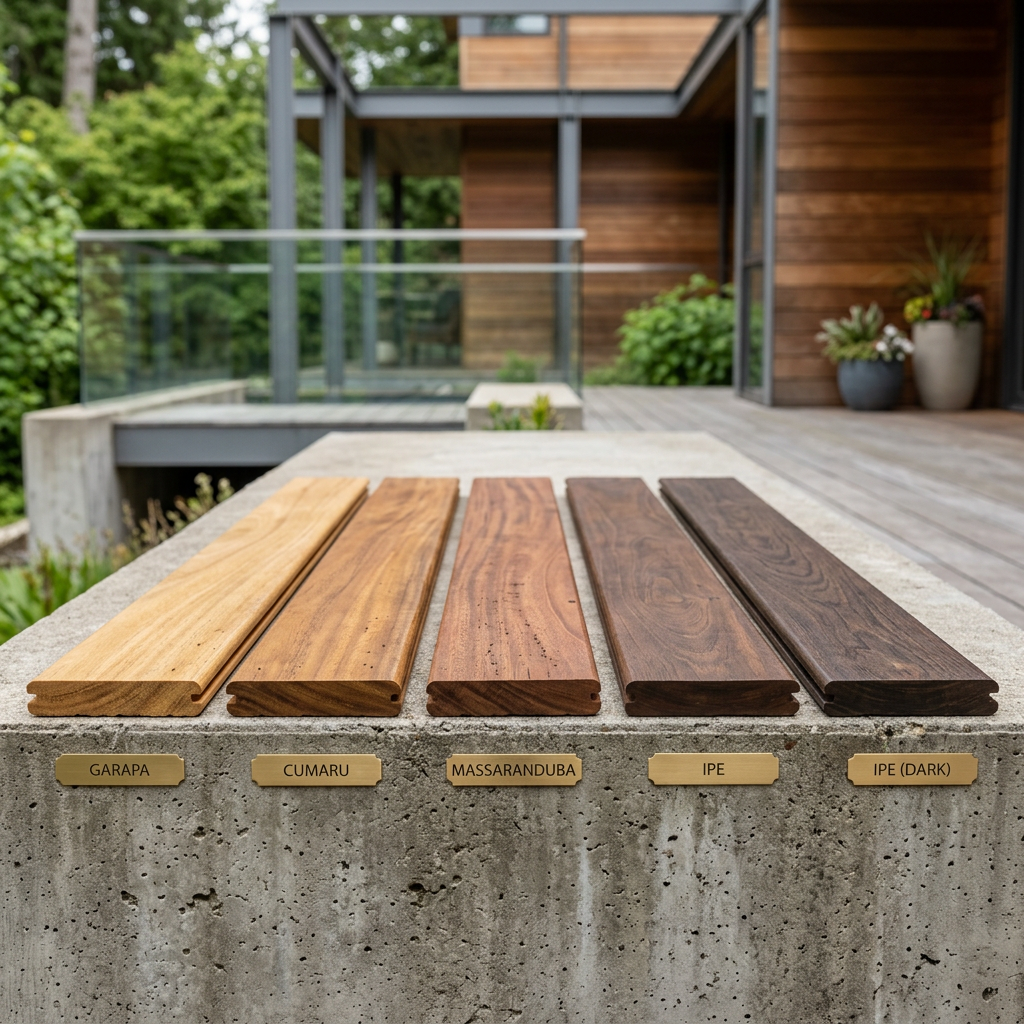
- Garapa (Apuleia leiocarpa): Light yellow with a fine grain, known for its affordability. Janka hardness: 1,650 lbf. Shop Garapa decking.
- Red Balau (Shorea spp.): Rich reddish-brown color with a straight grain, often used for decking. Janka hardness: 1,580 lbf. Shop Red Balau decking.
- Tigerwood (Astronium spp.): Characterized by its striking stripes, it offers a unique aesthetic. Janka hardness: 2,160 lbf. Shop Tigerwood decking.
- Cumaru (Dipteryx odorata): Dark brown with yellow streaks, chosen for its toughness. Janka hardness: 3,330 lbf. Shop Cumaru decking.
- Ipe (Handroanthus spp.): Deep brown to olive tone, considered the gold standard of hardwood decking. Janka hardness: 3,680 lbf. Shop Ipe decking.
Best Use Cases
- Garapa decking: Ideal for decks in mild climates or pool areas due to its moisture resistance.
- Red Balau decking: Great for covered areas and light-traffic residential projects.
- Tigerwood decking: Perfect for decorative purposes owing to its attractive appearance.
- Cumaru decking: Suitable for decks and docks thanks to its durability.
- Ipe decking: The top choice for upscale residential and commercial decking projects.
Clear Pros
- Garapa: Cost-effective and good moisture resistance. It's lightweight and easy to work with. Lifespan of 30+ years.
- Red Balau: Offers a beautiful color, excellent durability, and lower maintenance. Lifespan of 40+ years.
- Tigerwood: Unique appearance that stands out. It's also resistant to weather and insect damage. Lifespan of 40+ years.
- Cumaru: Very hard and resistant to wear, making it ideal for utility applications. Lifespan of 50+ years.
- Ipe: Exceptionally long lifespan of 75+ years and the highest resistance to weather conditions.
Clear Cons and Limitations
- Garapa: Less durable than more expensive options; may not hold up in extreme climates.
- Red Balau: Best for covered applications; variable grade quality.
- Tigerwood: Can fade if not maintained properly; pricier than some alternatives.
- Cumaru: Price can be high depending on the market; harder to find.
- Ipe: High cost and requires specialized tools for installation due to its density.
Installation Considerations
When installing tropical hardwoods, the type of fastening system is crucial. Ipe decking and Cumaru decking often benefit from grooved decking for hidden fasteners which provides a seamless appearance, while square edge boards for face-screwed decks offer traditional visibility. Ensure you account for proper joist spacing to prevent warping or buckling. Massaranduba decking is another excellent high-density option worth considering.
Common Mistakes and How to Avoid Them
- Neglecting Moisture Content: Always check the moisture content of the wood before installation. Ideal levels are around 8-12%.
- Incorrect Fastener Types: Use stainless steel or bronze fasteners to avoid corrosion.
- Skipping Sealing: Every species should be sealed to enhance longevity and appearance.
Cost Considerations
- Garapa decking: Cost-effective, averaging $3-5/sq. ft.
- Red Balau decking: Mid-range at $5-8/sq. ft.
- Tigerwood decking: Priced at approximately $4-6/sq. ft.
- Cumaru decking: Ranges from $5-9/sq. ft.
- Ipe decking: Premium and costly, starting around $8-15/sq. ft.
Maintenance and Longevity
Tropical hardwoods typically last decades. Routine cleaning, resealing every 1-2 years, and using specialized wood cleaners can significantly extend the life of your hardwood. Consider applying a UV protectant to spaces exposed to direct sunlight.
Real-world Recommendations
For budget-friendly projects, opt for Garapa decking or Red Balau decking. If your project's aesthetic is paramount, Tigerwood decking or Cumaru decking present unique looks. For high-end, long-lasting constructions, choose Ipe decking without reservation.
FAQ Section
-
What is the most affordable tropical hardwood?
- Garapa generally offers the best value for budget-conscious buyers.
-
How long can tropical hardwood last?
- With proper maintenance, lifespans range from 30+ years (Garapa) to 75+ years (Ipe), depending on the species.
-
Which tropical hardwood is best for decking?
- Ipe decking is often regarded as the best due to its durability and aesthetic appeal.
-
Can I install tropical hardwoods on my own?
- Yes, as long as you follow installation guidelines and use the right tools.
Compare Your Options
See how different hardwood species and materials stack up for your specific needs.